
Kitchen renovation mistakes are unfortunately common across the GTA. We see the aftermath regularly when stepping in for mid-project rescues.
Most of these costly errors are entirely preventable with the right planning.
Let us look at the data to understand where budgets usually derail. Our team will outline the seven most expensive traps and show you exactly how to bypass them.
Mistake 1: Hiring without a fixed-price contract
According to 2024 industry data, 53% of homeowners using contractors go over budget, with the average cost overrun hitting nearly 28%. You can avoid this trap by demanding a fixed-price contract before any work begins.
Time-and-materials contracts, or worse, verbal agreements, remain the primary cause of these financial disasters. The contractor has no incentive to control hours under those models. You have no contractual recourse when the bill comes in significantly above the estimate.
Our firm uses fixed-price contracts exclusively to prevent this exact scenario. The price on the contract should be the price on the final invoice.
Ensure your agreement includes specific line items for:
- Labour and project management
- Material procurement
- City permit fees
- Daily site cleanup
- Waste disposal
Allowances must be exact, such as a “$4,500 tile budget”, rather than vague verbal promises.
Mistake 2: Hiring an unlicensed or uninsured contractor
One of the top kitchen reno mistakes to avoid is hiring an unlicensed operator, which leaves you personally liable for onsite injuries. Always verify a contractor’s municipal ‘Building Renovator’ licence and Workplace Safety and Insurance Board (WSIB) clearance upfront.
Toronto strictly requires renovation contractors to hold active municipal licensing. Licensed professionals carry both proper liability insurance and active WSIB coverage. Unlicensed operators do not provide these necessary protections.
If an uninsured worker is injured on your property, you become personally liable under Ontario’s Occupiers’ Liability Act.
Our experts always provide current insurance documents upfront during the first meeting. This proactive step eliminates any guesswork regarding liability.
To protect yourself, request these specific verifications:
- Check the building renovator licence directly with the City of Toronto.
- Request current certificates of liability insurance.
- Ask for their recent WSIB clearance certificate.
- Verify both documents are printed in the corporation’s name, not a personal name.
Mistake 3: Skipping permits on permit-triggering scope
Unpermitted construction voids most home insurance policies and can trigger a City of Toronto stop-work order. You must pull a municipal building permit if your scope changes structure, plumbing, electrical, or ventilation systems.
Some contractors quietly skip this process to save you from perceived paperwork hassles, but this is terrible advice. The consequences of skipping this step are severe. You could face municipal fines ranging from $1,000 to $25,000 and be forced to tear down unauthorized work at your own expense.
As of 2026, the City of Toronto permit fee for interior alterations is just $11.53 per square meter, with a minimum flat fee of $214.79. This small fee acts as your insurance against massive future liabilities.
Our project managers handle permit filing as part of the standard contract. That guarantees the paperwork is filed correctly without causing you any stress.
Pull the permit immediately if your scope involves any of the following changes:
- Removing structural or load-bearing walls.
- Relocating major plumbing lines or drains.
- Altering the existing HVAC system.
- Creating a new secondary suite or basement apartment.
Mistake 4: Picking an island that doesn’t fit the work triangle
Squeezing an oversized island into a standard condo creates a daily traffic jam and ruins the kitchen’s functionality. You must stick strictly to the National Kitchen and Bath Association (NKBA) clearance standards of 42 to 48 inches for your work aisles.
We frequently rescue layouts where the island was sized purely for visual impact. A massive island looks generous on a floor plan but violates basic ergonomics in practice. With the average new Toronto condo size shrinking to just 650 square feet according to Statistics Canada, space planning is critical.
If the math simply does not work, a peninsula layout is a highly practical choice for smaller GTA homes.
Our designers always block out available workspace on the floor plan before recommending an island. Proper clearance ensures multiple people can cook together comfortably.
Follow these strict NKBA spacing guidelines for island placement:
- Maintain a minimum 42 inches of aisle space for a single cook.
- Expand to a minimum of 48 inches if two people regularly share the kitchen.
- Keep the path completely clear between the sink, stove, and refrigerator.
- Allow at least 15 inches of landing area on either side of the cooking surface.
Mistake 5: Buying cabinets first
Purchasing big-box store stock cabinets before hiring a contractor almost always results in wasted money and awkward layout gaps. You should pick your contractor first so they can order custom cabinetry based on exact, final room measurements.
Stock and semi-custom units are mass-produced in rigid 3-inch increments. True custom cabinetry, by contrast, is built to exact 1/8-inch measurements. Standard 3-inch boxes rarely fit unique older home dimensions cleanly.
When the math falls short, installers must use multiple 3-inch filler strips to close the gaps, leaving you with wasted space.
Our installation crew prefers working with custom or high-end semi-custom lines. Precision sizing maximizes your storage capacity and completely avoids the dreaded filler-strip cascade.
| Feature | Big-Box Stock Cabinets | True Custom Cabinets |
|---|---|---|
| Sizing | Mass-produced in rigid 3-inch increments | Built exactly to 1/8-inch measurements |
| Fit | Requires multiple filler strips to close wall gaps | Flawless wall-to-wall fit without wasted space |
| Lead Time | 1 to 2 weeks for delivery | 6 to 10 weeks for fabrication and delivery |
Mistake 6: Under-budgeting for the unknowns
Under-budgeting is one of the most common toronto kitchen renovation pitfalls, especially in pre-1980 homes hiding expensive structural surprises. You need to build a firm 10% to 20% financial contingency into your plan, kept entirely separate from the main contract.
Pre-1980 properties hide serious structural and electrical surprises behind the plaster. The first three days of demolition often reveal rotted subfloors or missing structural support. In historic neighbourhoods like The Annex or High Park, discovering old knob-and-tube wiring is incredibly common.
Replacing this fire hazard safely costs between $15,000 and $25,000 on average.
Our estimators actively flag these common surprise risks at your initial consultation. The fixed-price contract handles your known, in-scope work, while the contingency safety net handles those out-of-scope discoveries.
Common hidden discoveries in older GTA properties include:
- Active knob-and-tube electrical wiring.
- Asbestos hidden in old floor tiles or drywall joint compound.
- Water damage and severely rotted subfloors.
- Undersized or heavily corroded galvanized plumbing pipes.
Mistake 7: Picking finishes too late
Waiting too long to pick your materials will delay your entire project and leave your kitchen in a state of extended demolition. Finalize every finish selection, from custom cabinets to plumbing fixtures, before signing your construction contract.
Custom cabinet makers in the GTA currently average a 6 to 10-week lead time from order to delivery. Premium quartz countertops, like Cambria or Caesarstone, require an additional 2 to 3 weeks for templating and fabrication after the cabinets are installed. Hand-glazed tiles can easily run 4 to 8 weeks for delivery.
Our coordinators provide a detailed finish schedule at the consultation. Once you sign off, every single long-lead item is ordered immediately.
Typical 2026 material lead times you must plan for include:
- Custom kitchen cabinets: 6 to 10 weeks.
- Premium quartz countertops: 2 to 3 weeks post-cabinet installation.
- Specialty hand-glazed wall tile: 4 to 8 weeks.
- Custom plumbing fixtures and hardware: 2 to 4 weeks.
Red flags when interviewing contractors
A few critical warning signs should immediately pause your hiring process. According to Consumer Protection Ontario, a contractor demanding an unusually large upfront cash deposit is a major financial risk.
Watch out for these specific issues during your interviews:
- Refusal to put full pricing in a written contract.
- Demanding a massive cash deposit before any work begins.
- Inability to produce current WSIB clearance and liability insurance.
- High-pressure sales tactics demanding a signature at the initial consultation.
- Professional references that are entirely vague or impossible to verify.
- Subcontracting design, fabrication, and installation to completely different companies.
Our business model at Toronto Kitchen Renos avoids all these pitfalls. This approach relies entirely on fixed-price contracts, municipal licensing, in-house teams, and verified reviews on Google and HomeStars.
Do you want to talk through your specific project before committing to a plan?
Avoiding costly kitchen renovation mistakes starts with accurate upfront planning.
Book a free in-home consultation to discuss your exact needs. Our team will happily walk through the specific scope, budget, and risk areas for your home.
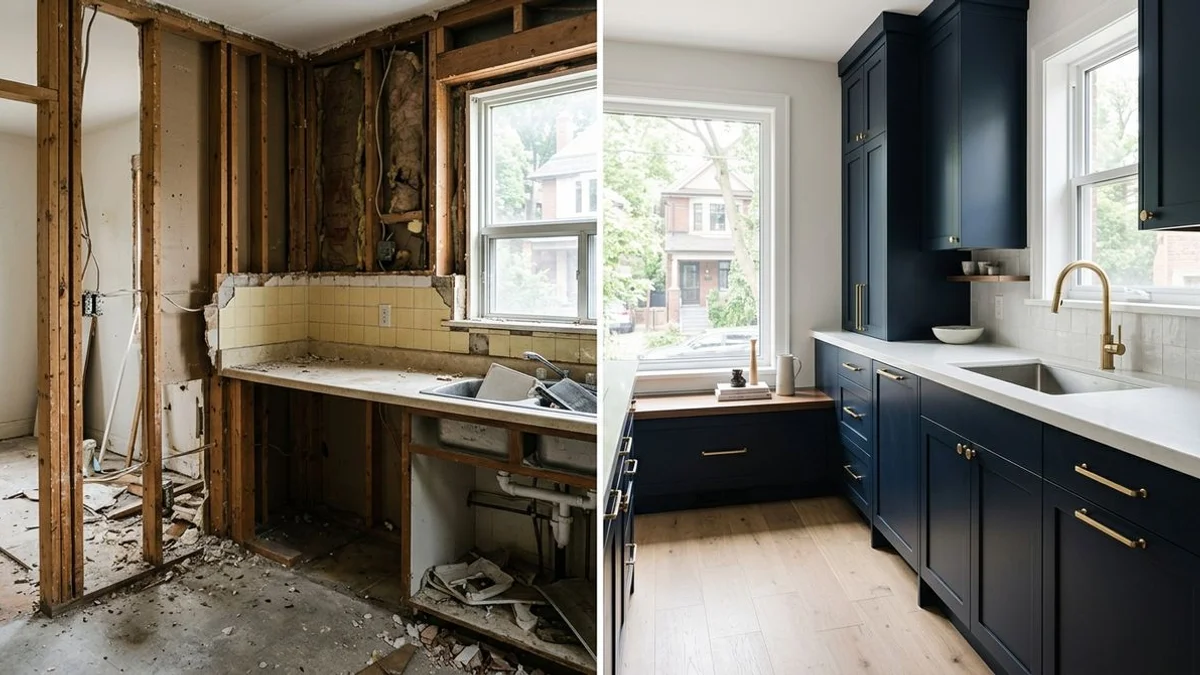
Before-and-after concept comparing a poorly executed renovation with a properly finished kitchen