Most people assume selecting cabinet finishes is the difficult part of a renovation. The floor plan actually dictates everything else.
We see homeowners constantly fighting against their structural footprint instead of working with it. This common mistake leads to cramped aisles and wasted budget. Poor planning limits your storage capacity from day one.
Our designers rely on proven kitchen layout types to solve these exact spatial problems.
Let’s look at the current data to help you identify the most efficient arrangement for your property.
The five core layouts
We classify almost every successful Greater Toronto Area project into one of five main categories. These primary shapes provide the foundation for efficient cooking and storage. Toronto general contractors use these exact templates before discussing cabinet colors or countertops.
- Galley: Two parallel runs of cabinetry.
- L-shape: Two perpendicular runs meeting at a corner.
- U-shape: Three connected walls forming a continuous counter.
- Island: A freestanding central unit paired with a perimeter run.
- Peninsula: A connected counter extension forming a partial border.
Galley
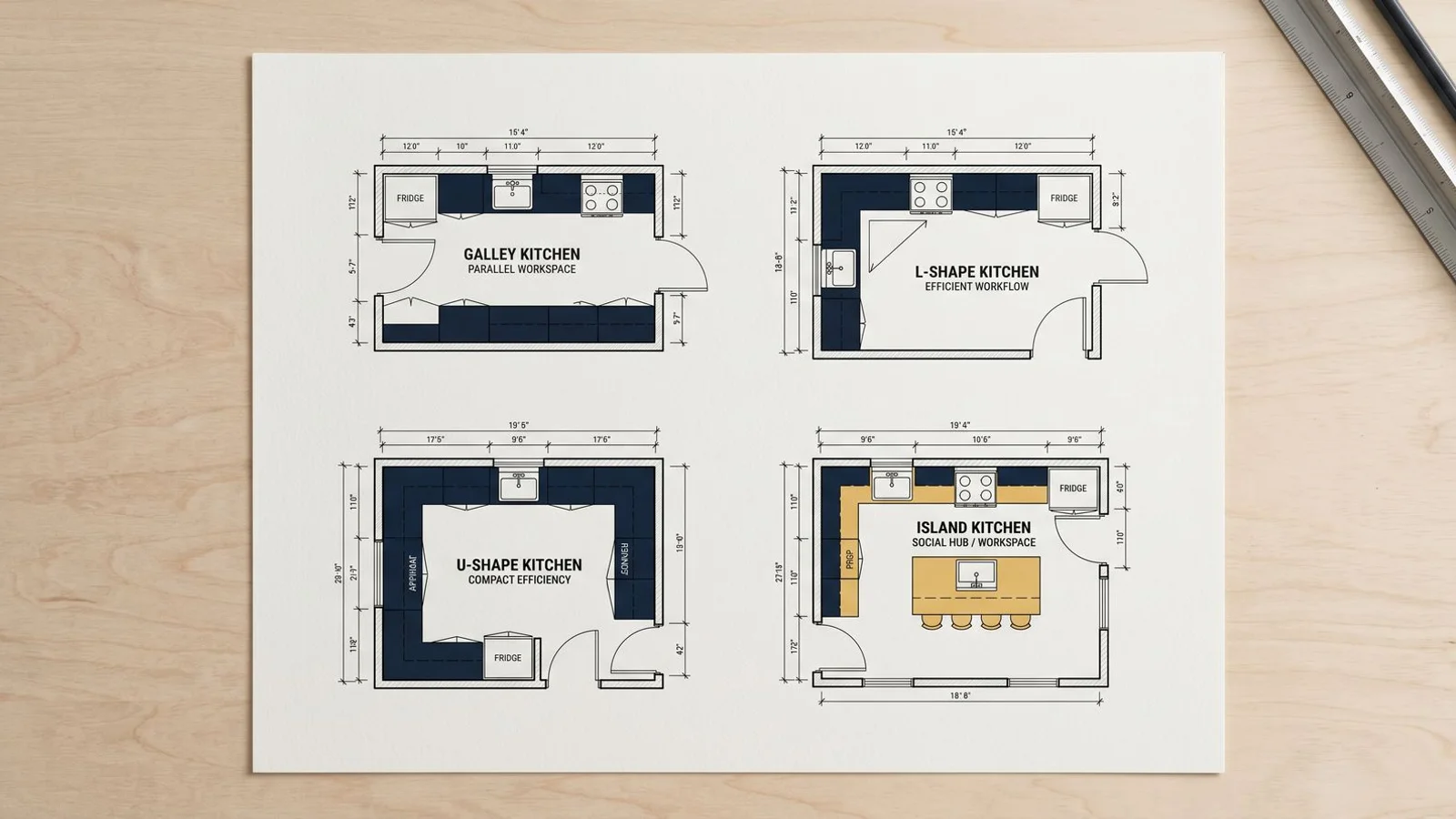
A galley kitchen layout features two parallel runs of cabinetry separated by a central walking space. This creates an incredibly efficient cooking zone within a tight area. Our installation teams frequently use this specific design in downtown Toronto condos. Most of these compact urban spaces measure between 60 and 120 square feet. Taking custom upper cabinets all the way to the ceiling eliminates the standard 30-inch dead zone found in older units.
We recommend pairing this vertical storage strategy with 24-inch counter-depth refrigerators. Brands like Liebherr manufacture excellent slim models that prevent large appliance doors from blocking the central walkway. The average galley footprint requires roughly 70 to 150 square feet.
Strengths:
- Maximum counter area within a minimal footprint.
- Everything stays within a single step or pivot.
- Custom pull-out pantries fit easily at the ends.
Weaknesses:
- Multiple cooks can easily cross paths and bump elbows.
- No room exists for casual seating without knocking down a wall.
- The enclosed shape often blocks natural light from adjoining rooms.
Best Toronto fit: Narrow Victorian semis in the Annex and Riverdale, Roncesvalles townhouses, and one-wall exterior glazing condo units.
L-shape
An l-shape kitchen utilizes two perpendicular counter runs that meet at a single corner. This setup remains the most popular choice for modern open-concept renovations. We install the L-shape in roughly 40 percent of our remodeling projects. This adaptable shape easily integrates into open living and dining areas. Proper planning accommodates almost any architectural challenge you face.
The biggest pitfall is ignoring the dead corner space where the two walls meet. Standard shelves make it impossible to reach heavy pots pushed to the back. Our solution involves installing advanced blind corner optimizers right from the start. The Hafele LeMans II system costs roughly $710 CAD and completely transforms this awkward zone. Each pivoting tray holds up to 55 pounds for secure cast iron storage.
Strengths:
- Adapts easily to both small and large room dimensions.
- Allows clear traffic flow without central bottlenecks.
- Leaves floor space for a dining table or movable prep cart.
Weaknesses:
- Storage capacity drops if corner cabinets lack pull-out hardware.
- Prep zones can feel too spread out in very large rooms.
- Less dedicated pantry space exists compared to a full U-shape.
Typical footprint: 100 to 250 square feet.
Best Toronto fit: Detached and semi-detached properties in North York, Scarborough, and Mississauga, Etobicoke bungalows, and mid-size condos or townhouses.
U-shape
A U-shape layout consists of three connected cabinet runs that form a continuous perimeter. Two deep corners provide massive storage potential for heavy equipment. We strongly recommend the U-shape for households that require maximum countertop space. This highly functional design easily supports multiple cooks preparing complex meals simultaneously. Clients often request this exact setup when converting a separate dining room into a dedicated culinary space.
You must watch the central aisle clearance closely during the planning phase. National Kitchen and Bath Association guidelines require a minimum 42-inch work aisle for a single cook. Our draftsmen push for 48 inches if two people regularly share the space. A narrow U-shape creates a claustrophobic environment that frustrates daily use.
Strengths:
- Creates a dedicated zone completely isolated from foot traffic.
- Provides three separate walls for dedicated prep stations.
- Accommodates large appliance packages easily without crowding.
Weaknesses:
- Two blind corners require expensive pull-out organizers.
- Additional cabinetry increases the average renovation budget significantly.
- Feeling boxed in is common if solid upper cabinets cover every wall.
Typical footprint: 150 to 300 square feet.
Best Toronto fit: Larger Toronto detached homes exceeding 3,000 square feet, Markham and Vaughan family homes, Oakville executive properties, and premium condos with dedicated kitchen rooms.
Island
An island layout combines a standard perimeter design with a freestanding central unit. The central structure must maintain at least a 42-inch clearance on all four sides. We view the island as the ultimate upgrade for open-concept residential homes. This premium addition serves as a prep station, casual dining area, and homework hub all at once. Installations frequently include secondary prep sinks or under-counter beverage fridges.
Adding this feature requires a massive footprint and a healthy budget. The room itself usually needs to measure at least 200 square feet. Our project managers remind clients that proper seating requires a 15-inch knee clearance for standard 36-inch high counters. Custom island fabrication also adds between $5,000 and $15,000 CAD to your total project cost.
Strengths:
- Defines the cooking zone visually within a larger open room.
- Provides a centralized gathering spot for entertaining guests.
- Allows the active cook to face guests instead of staring at a wall.
Weaknesses:
- Poor sizing severely disrupts the primary household traffic flow.
- Trenching a concrete slab for island plumbing drives up labor costs.
- Wastes valuable floor space if the surrounding aisles are too wide.
Typical footprint to support an island: 200+ square feet.
Best Toronto fit: Spacious detached properties, large semi-detached main floors, and premium condominiums with a dedicated kitchen footprint.
Peninsula
A peninsula features an L-shape or galley perimeter connected to a protruding counter extension. One side anchors securely to a structural wall while the other three remain open. We use peninsulas to separate living areas visually without building restrictive drywall barriers. This smart compromise delivers casual seating and extra prep space simultaneously. The layout works perfectly when a room is just slightly too narrow for a true freestanding unit.
The attached design naturally guides foot traffic away from the hot stove. This makes it an incredibly safe layout for families with young children. Our teams love how it provides the social benefits of an island while keeping the renovation costs significantly lower.
Strengths:
- Solves basic seating needs in medium-sized square footage.
- Acts as a physical barrier to keep guests out of the prep zone.
- Eliminates the expensive need to run new plumbing through the floor center.
Weaknesses:
- Creates a directional bottleneck at the single room entry point.
- Corner cabinet access where the peninsula meets the wall is frequently awkward.
- Looks visually less symmetrical than a perfectly centralized island.
Typical footprint: 120 to 250 square feet.
Best Toronto fit: Medium-sized Toronto homes, semi-open condo layouts, standard townhouses, and kitchens too small for true islands.
NKBA standards every layout follows
The National Kitchen and Bath Association establishes strict clearance and distance rules for safety. Every successful layout must adhere to these exact ergonomic benchmarks. We strictly enforce these industry standards to guarantee your new space actually functions beautifully. A flawless design on paper means absolutely nothing if you cannot open the oven door fully. The drafting process checks every single measurement against the latest 2026 guidelines.
Ignoring these numbers guarantees a frustrating daily experience. For example, you need exactly 15 inches of landing counter space on the handle side of your refrigerator. Our inspectors use these precise dimensions to protect your long-term investment.
Key Clearance Rules
- Work triangle perimeter: The sum of the three primary legs must equal 13 to 26 feet total.
- Individual leg length: Each specific side of the triangle must measure between 4 and 9 feet.
- Traffic flow: Major household pathways must never cross through the active work triangle.
- Aisle width: You need 42 inches between opposing counters for one cook, and 48 inches for two.
- Sink prep area: The continuous counter directly beside the sink requires a 36-inch minimum width.
- Cooktop clearance: Allow at least 15 inches of landing space on one side of the cooktop, and 12 inches on the other side.
These fundamental metrics originated from decades of rigorous ergonomic testing. Layouts that violate them feel cramped and dangerous regardless of their visual appeal.
Picking the right layout
Choosing the correct layout requires filtering your structural options through your physical space, lifestyle, and budget. You must align these three critical factors to find the perfect match. We guide clients through a specific assessment process to narrow down the choices accurately. Forcing a massive island into a narrow room will only cause immediate regret. The primary goal is to maximize daily functionality within your realistic constraints.
Here is how to evaluate your options logically:
1. Evaluate the footprint
Physical property boundaries dictate your absolute starting point. A long, narrow room naturally demands a streamlined galley or standard L-shape. We find that square rooms easily accommodate a highly functional U-shape setup. Open-plan properties comfortably support the large clearances required for heavy islands and peninsulas.
2. Match your cooking style
Your daily culinary habits matter just as much as the strict wall dimensions. A single cook doing basic meal prep thrives perfectly in an efficient galley. We strongly suggest an island if your children routinely do homework nearby while you prepare dinner. Heavy entertainers or multi-cook households require the separated zones of a large U-shape.
3. Review the budget impact
Cabinetry and labor costs fluctuate wildly based entirely on the shape you choose. The average kitchen renovation in Toronto currently runs between $15,500 and $25,500 for a standard basic remodel. We consider the galley and L-shape to be the most cost-effective routes available. Adding a U-shape automatically increases costs by 10 to 15 percent due to the extra corner mechanisms. Introducing a large custom island predictably bumps the budget up by 20 to 30 percent to cover the unit and any required plumbing. A peninsula falls right between the L-shape and an island in terms of cost.
Which layouts we recommend most often
Based on recent local data, the versatile L-shape continues to dominate the regional renovation market. This statistic clearly reflects the standard architectural footprints found throughout the city. We intentionally adapt our structural designs to enhance the existing property rather than fighting against it. Single-wall layouts remain exceptionally rare, appearing almost exclusively in tiny downtown studio apartments. Project data from 2024 through 2026 shows a massive preference for flexible, open designs.
Our Project Breakdown
| Layout Style | Percentage of Projects | Ideal Property Application |
|---|---|---|
| L-shape | ~40% | Maximum flexibility in standard detached homes |
| L-shape with peninsula | ~20% | Adding seating to medium urban spaces |
| Galley (including condos) | ~20% | Narrow condo units and historic semis |
| U-shape | ~10% | Dedicated chefs and large suburban families |
| Island (freestanding) | ~10% | Open-concept luxury real estate properties |
The dominance of the L-shape simply proves that local homeowners prioritize highly adaptable, open spaces. Your specific structural measurements will naturally dictate which design makes the most logical sense. We always aim to maximize the specific dimensions of your property without wasting budget.
If you need more kitchen layout ideas to start visualizing the changes, Browse our kitchen design service to explore recent transformations in your neighborhood. You can also review how to plan a Toronto kitchen renovation for a detailed breakdown of the exact permitting process.
If you are ready to start measuring, book a free in-home consultation to walk through which exact floor plan fits your property.
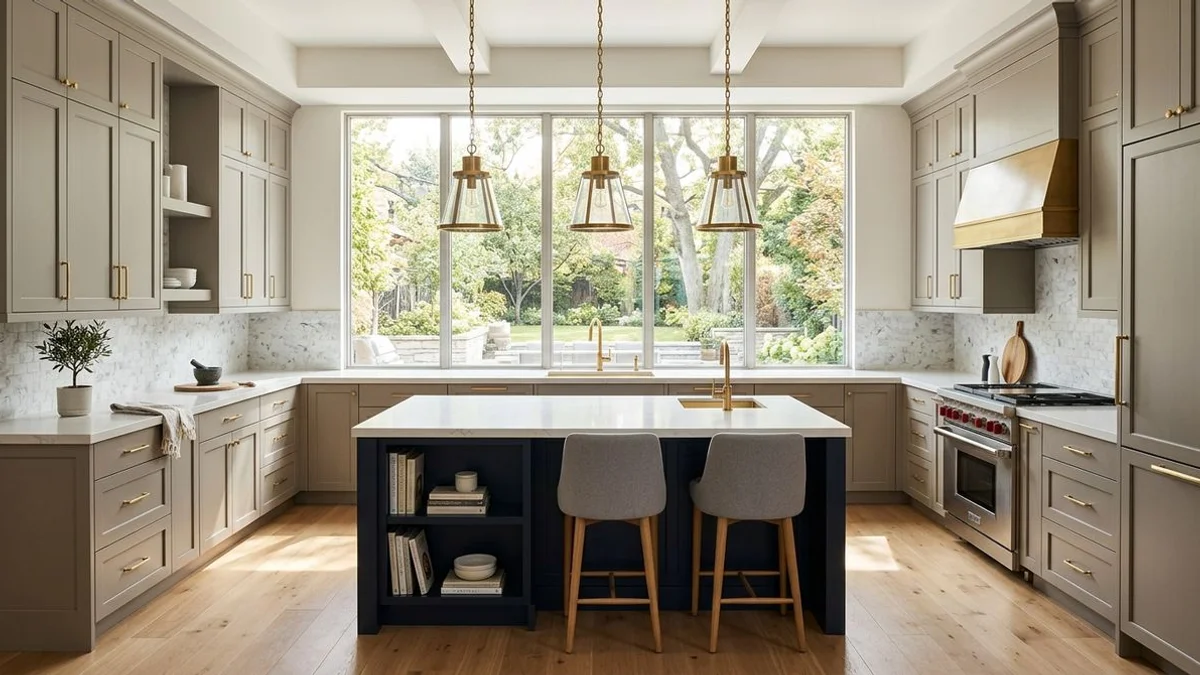
U-shape Toronto family kitchen with island