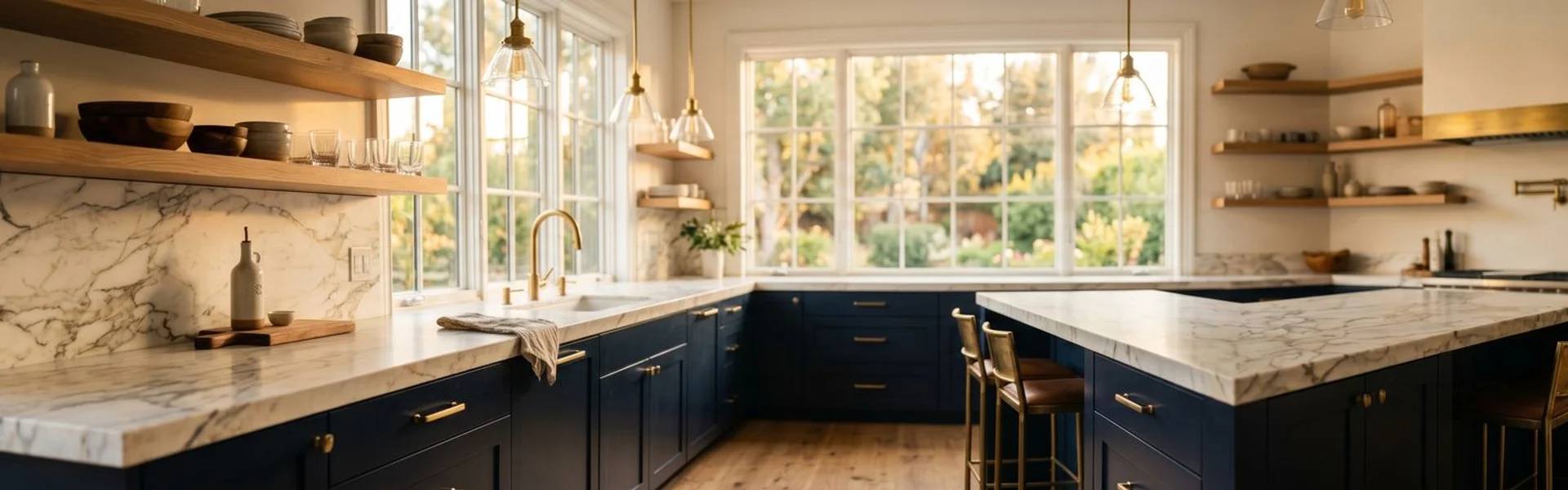
You know the frustration of seeing a beautiful design turn into a chaotic construction site. We see this disconnect happen constantly when roles get blurred. The kitchen designer role gets confused with interior decorator, architect, or general contractor on a regular basis.
Our team wants to clear up this confusion right now.
Here is the plain-language description of what a kitchen designer actually does, when you need one, and how it differs from the related disciplines. We will walk through the exact scope of work and how to hire the right professional.
What kitchen designers actually deliver
Kitchen designers provide a complete package covering functional layout, aesthetic direction, and construction-ready drawings. Our team breaks this full scope into six main deliverables. A complete kitchen design package includes:
- Functional layout: The work triangle (sink, stove, fridge), traffic flow, prep zones, clean-up zones, storage, and how the kitchen connects to dining and living spaces.
- Aesthetic direction: Cabinet style, finish, counter material, backsplash tile, hardware, lighting, and plumbing fixtures.
- 3D rendering: Photorealistic visualization of the finished kitchen so you see the design before fabrication starts.
- Material specifications: Detailed schedule of every material covering cabinet box and door material, counter slab, tile, hardware part numbers, and lighting models.
- Construction-ready drawings: Plan view, elevation views, section views, and detailed cabinet drawings with dimensions to the millimetre.
- Project documentation: Specifications, finish schedule, cabinet schedule, and appliance specs create the package that contractors fabricate and install from.
That is the full scope. Our designers know some firms stop at concept and rendering, while others continue through construction documentation. NKBA-certified designers work to a published standard for both phases. Our team maintains the NKBA Canada standard of at least 91 centimetres (36 inches) of continuous prep counter space for every project.
What kitchen designers don’t do
Kitchen designers focus on planning, so they do not engineer structural changes, fabricate cabinets, or manage daily trades. We always outline three specific boundaries before starting a project. These limits are worth understanding:
- They do not structure buildings: That is an architect or structural engineer’s job.
- They do not fabricate cabinets: That is a cabinet shop’s job.
- They do not manage the renovation: That is a project manager or general contractor’s job.
Our shop uses a single-team model where the designer is on staff alongside the cabinet shop and install crew. In a fragmented model, you might engage a designer separately and hand their drawings to a contractor. We recommend clarifying these boundaries early to avoid costly assumptions.
Our projects involving a load-bearing wall removal in Toronto require a structural engineer and a specific City of Toronto Building Permit. This building permit process costs between $200 and $600 in 2026.
Where designer ends and contractor begins
The designer is responsible for the vision and specifications, while the contractor handles physical execution and project management. We find this division of labour works best when defined clearly with actual numbers attached.
| Role | Core Responsibilities | Average 2026 Timeline & Cost |
|---|---|---|
| Designer | 3D renderings, material schedules, permit-ready drawings. | 2 to 4 weeks ($1,500 to $5,000 fee) |
| Contractor | Demolition, rough-in trades, cabinet install, finishing. | 10 to 14 weeks ($15,500+ build cost) |
When the designer and contractor are different companies, handoff issues are common. Our experience shows this leads to drawings that are technically buildable but practically problematic. Materials might be specified but unavailable, or schedule expectations might not match reality.
We track custom cabinet lead times in the GTA, which currently run 6 to 10 weeks in 2026. A disconnect here causes massive delays. Our shop puts everyone under one roof, allowing the designer to participate from concept through walkthrough. Drawings get adjusted based on field realities. We watch the designer see how their decisions land and incorporate lessons into the next project.
When you need a designer separate from your contractor
You should hire an independent designer if your contractor lacks in-house capabilities or you are managing the build yourself. We see standalone design working well in a few specific scenarios. It makes sense to engage a designer independently when:
- You are working with a small contractor who does not have design capability in-house.
- You are owner-building and managing trades yourself.
- You want a specific designer’s aesthetic that the chosen contractor cannot deliver.
- You are commissioning a pre-listing renovation and want a professional stamp on the specification.
We advise clients to expect to pay $1,500 to $5,000 for standalone kitchen design in Toronto, depending on the scope. A standalone specification package acts as a blueprint. Our independent clients use these documents to secure highly accurate bids from multiple contractors.
When in-house design (with the contractor) makes sense
Bundling design and construction offers a single point of accountability and speeds up the renovation timeline. We believe an in-house design model is cleaner for most homeowners. This approach provides several major advantages:
- Single point of contact from concept through walkthrough.
- No handoff gaps or coordination issues.
- Design decisions informed by what the cabinet shop can actually fabricate.
- No separate design fee on top of the renovation contract.
- Faster turnaround because design and contract run in parallel.
We track current local data showing a complete upscale kitchen remodel in Toronto ranges from $15,500 to well over $40,000 in 2026. Running the design phase concurrently with the building permit application saves two to four weeks off your total schedule. Our integrated approach keeps those high budgets strictly controlled.
What credentials matter
The most important credential is certification from the National Kitchen and Bath Association (NKBA). We always look for two relevant designations:
- CKD: Certified Kitchen Designer. This is the standard professional certification.
- CMKBD: Certified Master Kitchen and Bath Designer. This is the senior-level designation.
NKBA-certified designers work to published clearance standards and have demonstrated portfolio quality. We strictly adhere to the Canadian standard work triangle, keeping the legs between 1.2 and 2.7 metres. Other credentials sometimes encountered provide a solid baseline:
- Diploma in interior design: Programs from George Brown College or Sheridan provide a strong foundation.
- Chief Architect Premier certification: This proves 3D drawing software competence.
- Graphic certifications: Programs like BCIN in Ontario demonstrate building code knowledge.
What to ask at the consultation
Use the consultation to verify their local experience, revision policies, and software capabilities. We recommend asking specific questions to evaluate designers or the design portion of a contractor’s offering. Bring this list to your first meeting:
- Are you NKBA-certified?
- Do you carry valid WSIB coverage for your team?
- How many kitchens have you designed in Toronto?
- Can I see drawings from a recent completed project?
- What is your revision policy?
- Do you do construction documentation or stop at concept?
- Can I see your software output?
We suggest verifying if they design around current 2026 appliance dimensions, which are deeper than older models. Taking time to ask these questions prevents expensive rework later.
Our designers
Toronto Kitchen Renos provides NKBA-certified professionals on staff for every full renovation contract. We ensure they handle layout, 3D rendering, material selection, and construction-ready drawings. Standalone design is available for owner-builders and homeowners working with separate contractors.
We invite you to Browse our kitchen design service, see the cost ranges for kitchen design in Ontario, or book a free in-home consultation. The design conversation starts at the visit.
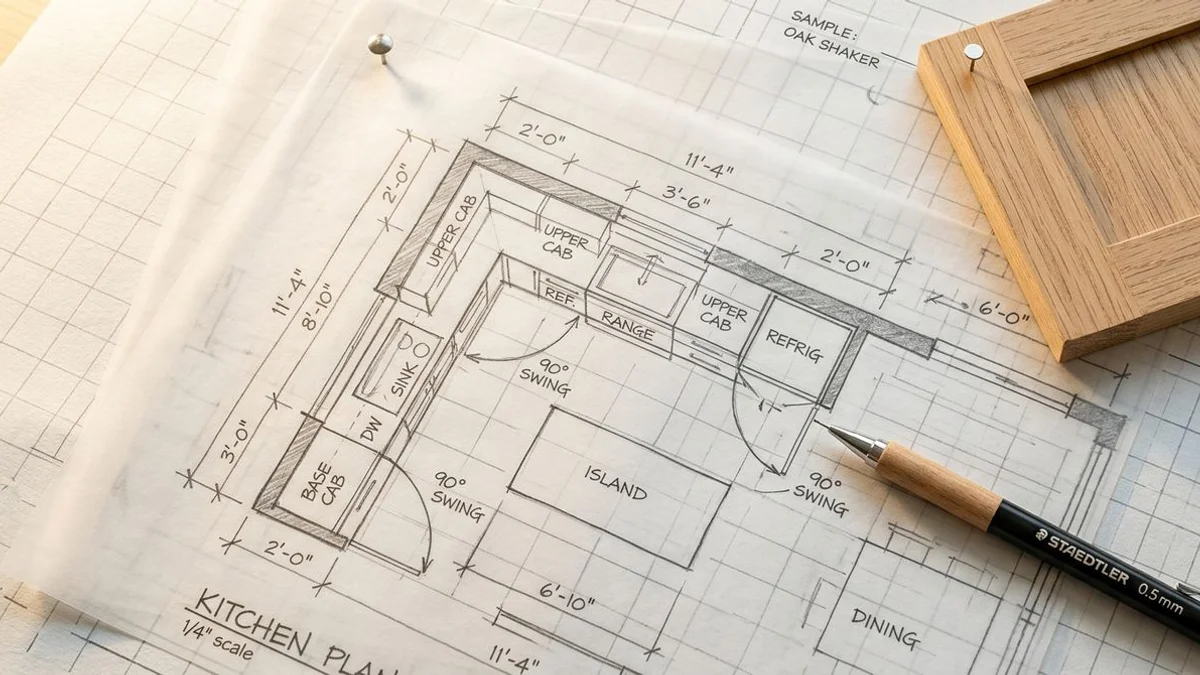
Hand sketching a kitchen layout on tracing paper