We often observe GTA property owners struggling to evaluate custom vs stock kitchen cabinets for their upcoming renovations.
That single choice dictates a massive portion of your 2026 renovation timeline and budget. The wrong tier frequently leads to wasted space and unexpected costs.
Our team consistently relies on a clear framework to match projects with the right cabinetry. Let’s analyze the hard data to help you make a confident, cost-effective decision.
Quick comparison
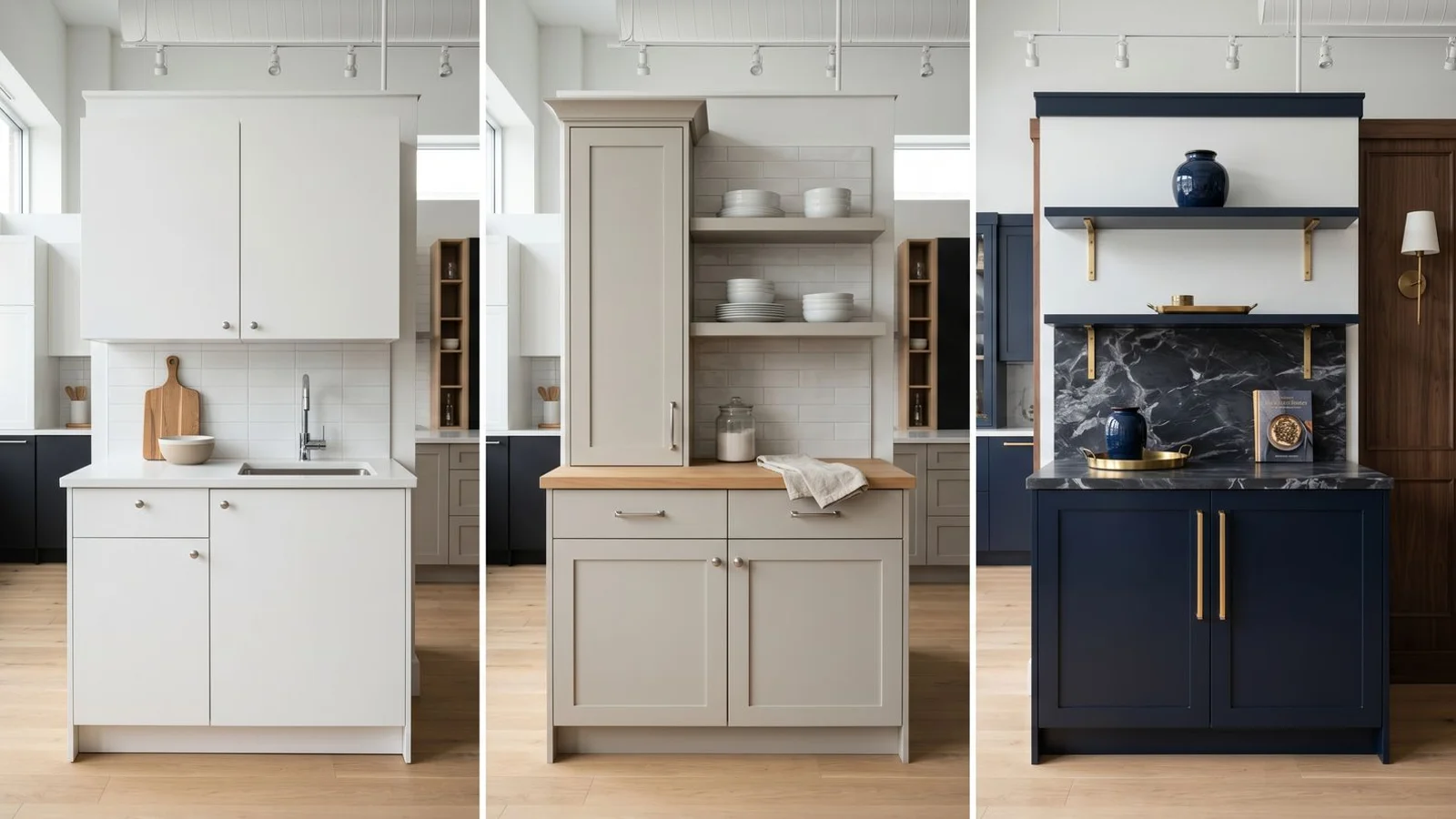
Comparing stock cabinets vs custom options side-by-side reveals immediate differences in cost, construction, and lead time. This quick reference table highlights exactly what you can expect across the three main categories.
| Factor | Stock | Semi-Custom | Full Custom |
|---|---|---|---|
| Per-linear-foot cost | $250-$500 | $400-$800 | $800-$1,500 |
| Lead time | In stock (immediate) | 4-8 weeks | 6-10 weeks |
| Box sizes | Fixed (3” increments) | Some flexibility | Built to exact dimensions |
| Door styles | Limited catalog | Wider catalog | Anything you specify |
| Finishes | Limited paint colours | Moderate catalog | Custom paint, stain, lacquer |
| Hardware | Basic pulls | Mid-tier upgrades | Premium (Blum, Hettich) |
| Useful life | 7-10 years | 10-15 years | 15-20+ years |
| Warranty | 1-5 years typical | 5-10 years | 10+ years |
Stock cabinets: when they make sense
Stock cabinets are pre-built units sold directly off the shelf in fixed dimensions. You purchase them exactly as they are from major retailers like IKEA or Home Depot’s Hampton Bay line.
These units are mass-produced in standard three-inch increments.
Our installation crews usually recommend this tier exclusively for fast rental flips or strict budgets under $15,000.
They serve a specific purpose but come with clear limitations.
Ideal Scenarios for Stock
You should consider off-the-shelf options if your project meets very specific criteria.
- You plan to sell a flip property within 18 months.
- The kitchen footprint perfectly matches standard sizing without major gaps.
- Your total renovation budget caps at $15,000 for a full kitchen.
- A unique or high-end aesthetic is not a priority.
Common Pitfalls and Warnings
We frequently see homeowners regret stock purchases when their walls are not perfectly plumb.
Filler strips quickly multiply to cover gaps when standard sizing misses the mark. Most budget lines rely heavily on particleboard boxes, which typically degrade or warp within seven to ten years of daily use.
The included hardware often fails first. Factory finishes are sprayed quickly, leaving very little tolerance for touch-ups down the road.
Semi-custom: the middle path
Semi-custom cabinets bridge the gap by offering a defined catalog of sizes combined with upgraded finish options. They are manufactured to order by Canadian brands like AyA Kitchens or Kitchen Craft rather than pulled from a warehouse shelf.
This tier provides better quality control and a few dimensional tweaks.
Our designers find this to be a solid compromise for a standard $25,000 to $45,000 kitchen budget.
When to Choose Semi-Custom
This middle tier works well for predictable layouts.
- The room features a highly standard, square layout.
- You require a specific paint colour unavailable in big-box stores.
- The project sits comfortably in the mid-range budget bracket.
- You plan to stay in the home for the next five to ten years.
Structural Strengths
You can usually secure plywood box construction at this level. Never accept particleboard if you are paying semi-custom prices. Manufacturers typically include better standard hardware, frequently utilizing reliable Blum hinges.
Lead times hover around four to eight weeks, keeping your project moving faster than a fully customized build.
Potential Limitations
We do want to highlight a few constraints with this middle option. Box dimensions still rely on three-inch increments for the most part.
This rigidity often leads to a few common issues:
- Older Toronto properties almost certainly require some filler strips to close awkward gaps.
- Finish quality varies wildly by manufacturer.
- Some doors look premium while others feel surprisingly cheap.
Full custom: when it’s worth the premium
Full custom cabinets are engineered entirely from scratch to match the exact millimeter of your specific floor plan. Every single element, from the raw plywood box to the specialized hinges, is built to your precise requests.
This tier eliminates compromise and maximizes every inch of available space.
“A fully customized approach expands usable storage in a downtown condo by roughly 30 percent simply by utilizing vertical height effectively.”
Our shop fabricates these units specifically for the unique architectural quirks found across the GTA.
Best Use Cases for Custom Millwork
A fully customized approach makes structural and financial sense in specific situations.
- The room features odd dimensions, sloping floors, or uneven walls.
- You require a specific wood species, stain, or architectural style.
- This is your long-term family residence meant to last decades.
- Premium durability and high-end finishes matter more than the initial price tag.
Core Advantages
We guarantee exact fits with zero need for awkward filler strips. Every box utilizes high-grade plywood for maximum structural integrity.
You dictate the exact materials, whether that means solid maple, premium MDF, or specialized acrylics. All moving parts rely on top-tier German or Austrian hardware from Hettich or Blum.
A single dedicated shop handles both the fabrication and the installation, creating a direct line of accountability.
Expected Trade-Offs
The premium quality naturally requires a larger investment. Expect the highest per-linear-foot cost and a longer lead time of six to ten weeks.
The process also demands more upfront design decisions before production begins.
Math example: 20-foot Toronto kitchen
A typical 20-foot linear run in a Toronto detached home costs between $12,000 and $36,000 total. The final price tag depends entirely on the material quality and installation tier you select.
Here is how the 2026 pricing breaks down across the three main categories.
- Stock: Cabinet materials run $5,000 to $10,000. Installation adds $3,000 to $5,000, plus extra labour to force filler strips into place. Total cost lands between $8,000 and $15,000.
- Semi-custom: Materials cost $8,000 to $16,000. Professional installation ranges from $4,000 to $6,000. Expect a total between $12,000 and $22,000.
- Full custom: Premium materials require $16,000 to $30,000. Installation costs $4,000 to $6,000, but avoids messy filler-strip work entirely. Total investment sits between $20,000 and $36,000.
Our clients often focus heavily on that initial price gap.
The longevity gap is equally important to calculate. Cheap particleboard boxes require full replacement in seven to ten years. Custom plywood construction easily lasts two decades or more.
Amortized over a 15-year lifecycle, the annual cost difference shrinks significantly.
Resale considerations
According to recent GTA real estate data, a high-quality kitchen renovation yields a 75 to 100 percent return on investment. Buyers scrutinize this room first and instantly recognize the difference between custom millwork and cheap big-box replacements.
In Toronto’s competitive housing market, perceived quality drives offer prices.
We see buyers penalize listings that feature obvious lipstick-on-a-pig renovations. A space fitted with exact-match cabinetry reads as a well-maintained, premium property. Conversely, budget materials signal to buyers that a complete renovation cycle is looming in the near future.
Impact on Different Property Types
Expectations shift based on your neighborhood and property value.
- Condos: Minor updates like new doors or quartz counters yield a 5 to 12 percent resale bump.
- Luxury Market: Homes listed over $1.5 million in areas like High Park or Oakville effectively require premium cabinetry.
- Mid-Market: A solid semi-custom layout holds its value well in standard suburban properties.
Installing budget cabinets in a million-dollar home actively harms your final sale price.
Why we focus on custom
Custom fabrication solves the precise structural challenges found in older Toronto properties. Standard boxes simply cannot accommodate the uneven walls, sloping floors, and odd alcoves typical of pre-1980 housing stock.
Our shop is specifically equipped for this kind of exacting, one-off fabrication. Gaps where standard sizing misses the ceiling require precise engineering to fix properly. A completely localized approach eliminates those messy compromises entirely.
This localized method guarantees several practical benefits:
- Perfect alignment with existing bulkheads and bulk ceilings.
- Zero reliance on cheap filler strips.
- Maximum utilization of tight corners in downtown layouts.
For full pricing detail, see our Ontario custom cabinet cost guide or explore our custom cabinets service directly.
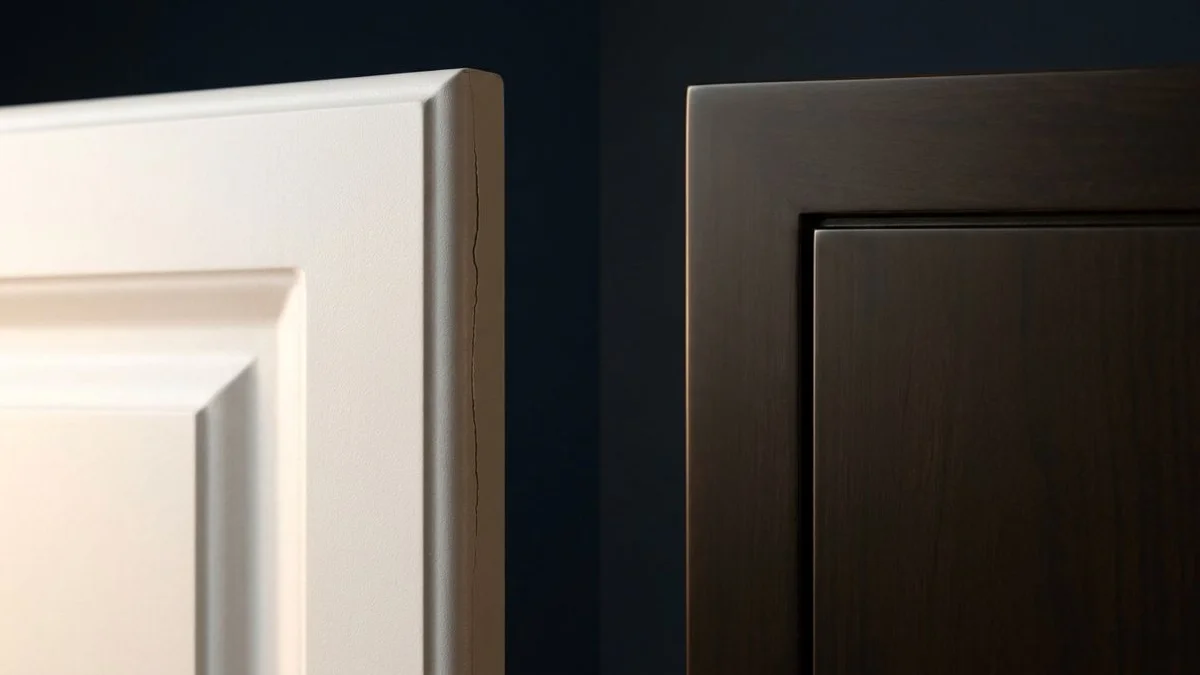
Close-up detail comparing stock and custom cabinet door finish quality