We know how heavily the renovation industry markets cosmetic updates right now. When weighing cabinet refacing vs replacing, the cheaper option gets pushed as a quick fix for almost any outdated space.
The reality is that keeping your old cabinet boxes fits a very specific use case.
From what we see in the field as a professional renovation team, putting new doors on failing frames will just cause you bigger headaches and doubled costs down the road. This strategy only works when the foundation is rock solid.
Here is an honest breakdown of the actual 2026 costs in the GTA, what the process covers, and how to choose the smartest investment for your property.
What refacing actually covers
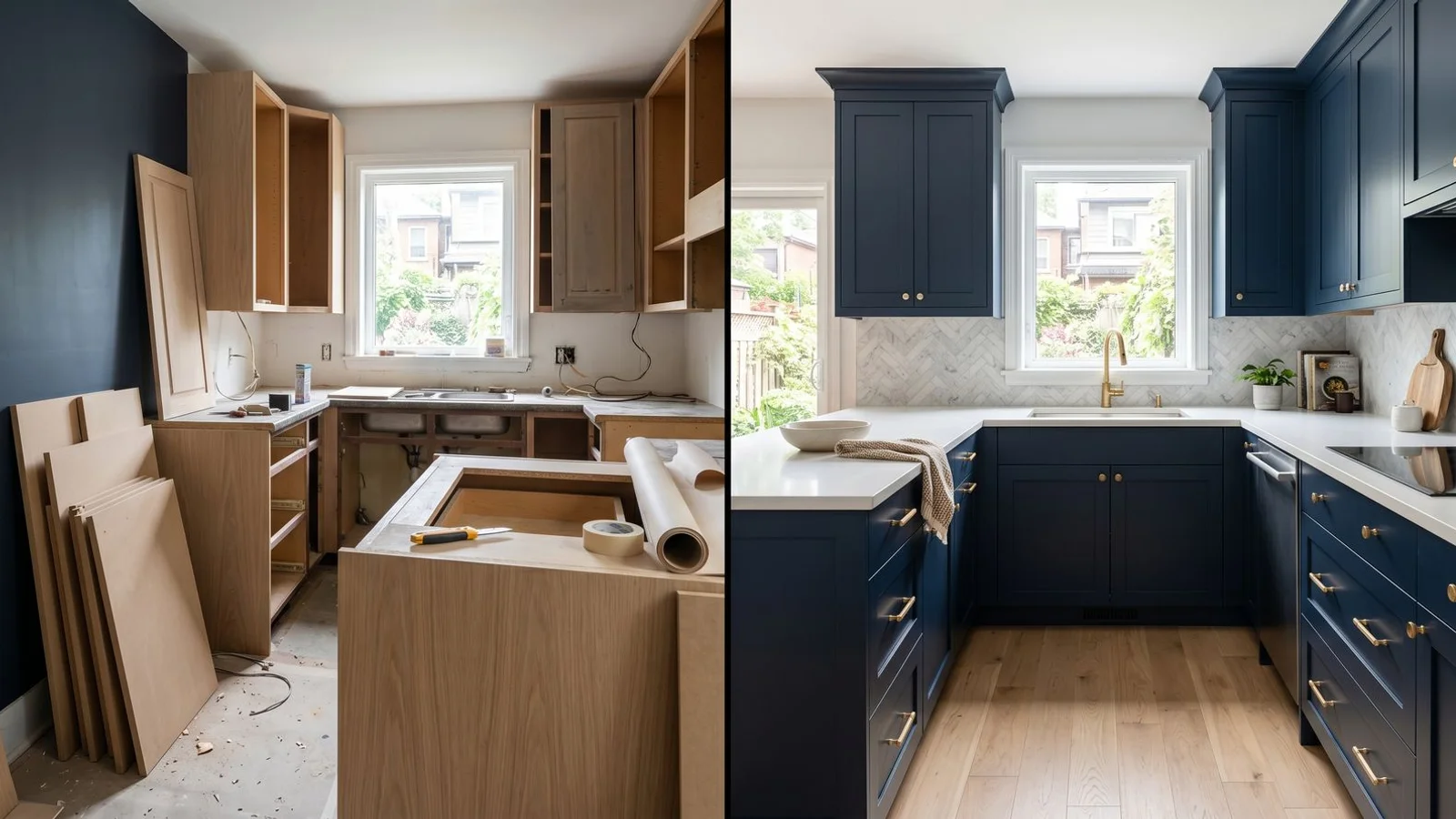
Cabinet refacing replaces the visible exterior surfaces of your kitchen while leaving the original structural boxes in place. This project swaps out your old aesthetic for a fresh one without requiring a full demolition.
Refacing keeps the existing cabinet boxes and replaces:
- All doors using modern materials like Rigid Thermofoil (RTF) or real wood veneer.
- All drawer fronts to match the new door profiles.
- Visible end panels and toe kicks.
- Exposed cabinet faces, which receive a new matching veneer skin.
What it does not cover:
- The cabinet boxes themselves, including sides, tops, and interior shelves.
- Hardware like hinges and drawer slides. Homeowners often upgrade to soft-close Blum hardware, but this represents an added cost.
- Your floor plan. The layout stays exactly where it is.
- Countertops, tile backsplashes, plumbing, and electrical work.
When refacing makes sense
Refacing is the right financial call when your kitchen layout is perfectly functional and the underlying cabinet structures remain rock solid. You get a completely modernized aesthetic for a fraction of the cost of starting from scratch.
This approach shines in a few specific situations:
- Your boxes are sound. Plywood boxes with square corners and zero water damage are prime candidates. This path gets you a fresh look for roughly half the cost of a custom replacement.
- You are prepping for a sale. The average Toronto home price hovers around $1.01 million in early 2026. If you own a condo or townhome in the $800,000 range, an $8,000 RTF reface delivers a high return on investment without overcapitalizing before listing.
- You have unusual custom dimensions. Many pre-1980 bungalows in areas like East York feature cabinet boxes built to odd sizes that no modern catalog matches. Keeping that existing fit avoids the high cost of custom fabrication.
When refacing is the wrong call
Refacing is a terrible idea if your current kitchen suffers from structural issues, poor flow, or extensive wear. Putting new doors on a failing foundation guarantees you will pay for another renovation within five years.
Skip the cosmetic updates and choose full replacement in these cases:
- Failing particleboard boxes. Older Medium Density Fiberboard (MDF) or particleboard that has softened or sagged cannot hold new heavy doors securely.
- Hidden water damage. Any swelling or mould behind the sink or dishwasher means the boxes must go.
- Required layout changes. If you want to remove a bulkhead to create an open-concept living area, you must tear out the old units.
- Kitchens older than 25 years. The construction standards of older units rarely support modern upgrades like full-extension heavy-duty drawer glides.
Cost comparison
When comparing cabinet refacing vs replacing, budget is often the deciding factor for property owners. Cabinet refacing typically lands at 40 to 60 percent of the cost of a full custom replacement for the cabinetry portion of your project.
Based on 2026 GTA market data from sources like HomeStars, the average cabinet refacing cost lands around $8,200. Custom replacements run much higher, often exceeding $50,000 locally depending on the materials and scope.
Here is a side-by-side look at what you can expect to spend in Toronto:
| Kitchen Size | Refacing Cost (2026) | Full Custom Replacement |
|---|---|---|
| Small (e.g., condo galley) | $4,000 - $8,000 | $15,000 - $25,000 |
| Mid-size (standard footprint) | $8,000 - $15,000 | $25,000 - $50,000 |
| Large (e.g., custom detached) | $15,000 - $25,000 | $50,000 - $100,000+ |
Timeline comparison
Refacing takes just 3 to 5 days of active on-site work, while a full kitchen replacement demands 8 to 14 weeks of construction. This project minimizes disruption, allowing you to use your kitchen for almost the entire process.
Refacing Timeline:
- The active on-site installation takes only 3 to 5 days.
- You will wait 4 to 6 weeks for the custom doors to be manufactured before work begins.
- The space remains functional right up until installation day.
Full Replacement Timeline:
- Expect 8 to 14 weeks of active construction from demolition to the final walkthrough.
- Custom cabinetry alone requires a 6 to 10 week lead time for manufacturing.
- You must factor in City of Toronto permit delays if you are moving plumbing or electrical lines.
Longevity comparison
The lifespan of a refaced kitchen depends entirely on the health of the original cabinet boxes. A brand new custom kitchen gives you a fresh 20-year warranty on the entire structure.
If the original boxes are sound when refaced:
- New high-quality RTF or wood veneer doors last 15 to 20 years.
- Reputable GTA refacing companies typically offer warranties covering peeling or delamination for 5 years.
- The original boxes act as the limiting factor. If they are 15 years old at the time of refacing, you can expect about 10 to 15 more useful years from them.
If the original boxes are already showing wear:
- Refacing buys you perhaps 5 to 7 years before the frames begin failing.
- At that point, you will have to pay for a full replacement anyway.
Resale implications
A refaced kitchen reads as a budget-conscious cosmetic refresh, while full replacement reads as a substantial property investment. Savvy buyers and professional home inspectors can easily spot the difference between the two.
For luxury homes in GTA neighbourhoods like Lawrence Park or Rosedale valued at $1.5 million and above, buyers expect a full structural renovation. A cosmetic update in this bracket often looks out of place and fails to deliver the expected wow factor.
In the 2026 Toronto housing market, where the average price hovers around $1.01 million, buyers are cautious. A clean presentation is critical, but overspending will not guarantee a return.
For properties in the $700,000 to $1 million range, refacing hits the sweet spot. A standard townhome in Vaughan or Markham benefits greatly from a fresh RTF finish, providing a modern presentation that photographs beautifully without requiring a massive upfront cash outlay.
Hybrid: partial replacement
A hybrid approach involves replacing heavily damaged cabinet sections while refacing the rest of the room to save money. Sometimes this blended method is the smartest way to maximize your budget and solve localized damage.
We frequently see kitchens where the sink base cabinet has suffered catastrophic water damage, but the upper cabinets look brand new. The trick is ensuring the new units perfectly match the older ones. UV fading on your existing finishes can make colour matching difficult.
We evaluate this option during your consultation to see if a hybrid model fits your space. This protects your investment while eliminating the damaged materials.
How we approach the refacing question
We evaluate your kitchen through the lens of long-term value and daily usability. When you ask yourself ‘should I reface or replace cabinets,’ the primary goal is to prevent you from wasting money on cosmetic fixes that will fail.
During an in-home assessment, our team focuses on four critical areas:
- Box condition: Our technicians check the material integrity, measure for squareness, and inspect for hidden water damage.
- Layout fit: The current configuration needs to serve your daily cooking habits effectively.
- Budget direction: We recommend refacing for $5,000 to $15,000 budgets and full replacement for $20,000+ goals.
- Time horizon: A planned move within 5 years makes refacing attractive, while a 10-year horizon favours replacement.
If a cosmetic update makes sense, we’ll handle the project from start to finish. To finally settle the cabinet refacing vs replacing debate for your home, the next step is a clear explanation and a fixed-price quote. Book a free in-home consultation to get an assessment for your kitchen.
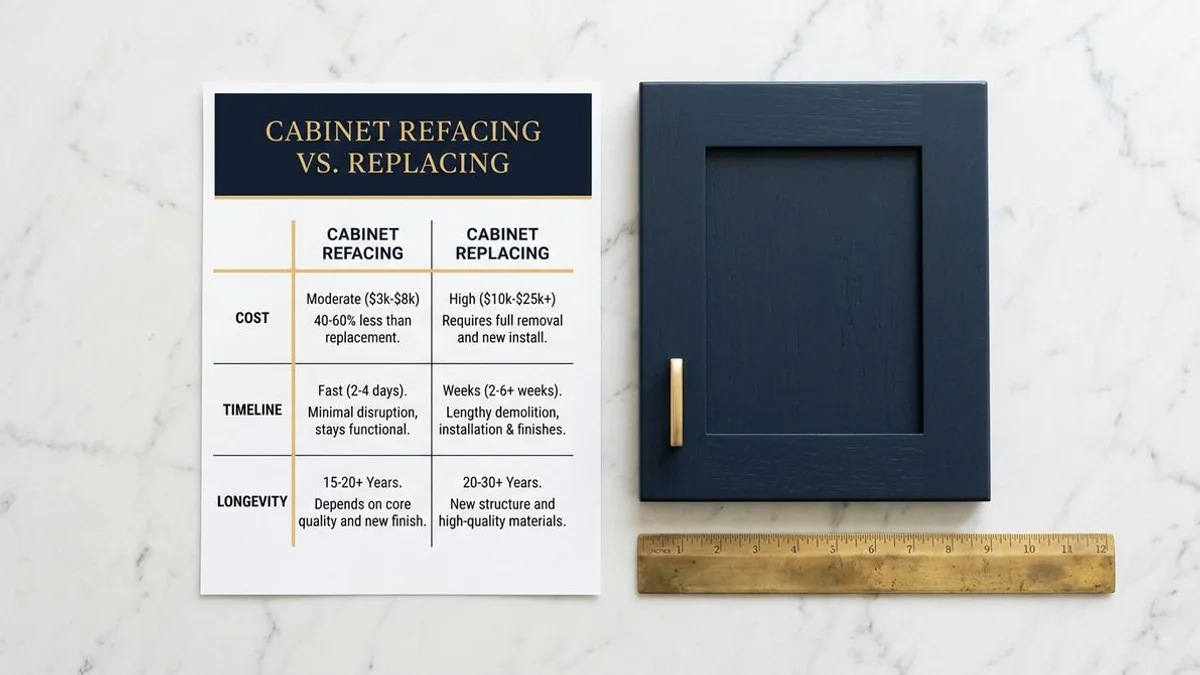
Comparison chart of refacing vs. replacing. Cost, timeline, longevity