Securing a condo board approval kitchen renovation is often the biggest administrative hurdle for Toronto homeowners.
We consistently see that the paperwork phase is where an unmanaged project falls off the rails.
This bottleneck happens because property managers must strictly protect a multi-million dollar shared building.
You need a clear strategy to get through the administrative red tape.
Our team handles these applications every single week across the GTA.
Let’s break down exactly what this formal process entails, the actual timelines, and how the right preparation prevents expensive delays.
Why every Toronto condo requires board approval
Every condominium corporation in Toronto has a legal duty to protect the building’s structural integrity and shared services.
Under Section 98 of the Ontario Condominium Act, property managers must regulate any interior modifications that could potentially impact common elements.
We read through dozens of building declarations each month, and they all share this same foundational requirement.
A simple pipe adjustment behind your drywall connects directly to the vertical plumbing stack shared by hundreds of other residents.
Therefore, any risk of a leak or electrical overload becomes a massive liability for the entire corporation.
Most buildings enforce this protection through a strict renovation application package.
Filing this paperwork correctly is your only path to starting construction legally.
Required approval typically covers these specific items:
- Any wall removal or structural relocation.
- Plumbing changes, even minor pipe shifts within the suite.
- Electrical modifications outside the original builder layout.
- Ventilation adjustments for your range hood ducting or bathroom exhaust.
- Hard floor finishes that alter acoustic impact ratings for the units below.
- Purely cosmetic work in buildings with highly restrictive declarations.
For a typical kitchen scope, this means filing a formal renovation application with the property manager before a single hammer swings.
What the application packet includes
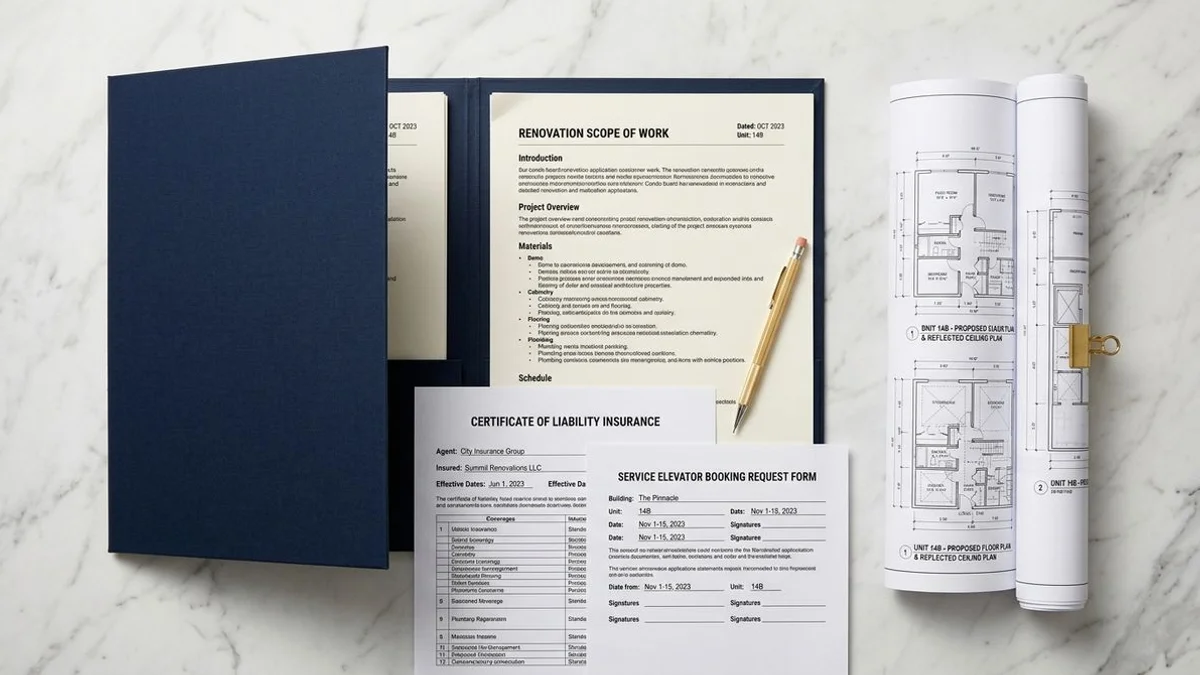
A complete application requires a standardized building form, comprehensive contractor insurance, detailed scope drawings, and a project schedule.
We prepare these exact documents for every project to ensure a fast, frictionless review.
Property management platforms like Condo Control are now standard for submitting these files in many Crossbridge and Del managed buildings.
A complete condo renovation application Toronto property managers expect typically requires the following documents:
- Renovation application form. Provided by the building to name the unit, outline the exact scope of work, list the contractor, and define start and end dates.
- Contractor insurance and WSIB clearance. You need a certificate of insurance naming the corporation as an additional insured party, typically carrying $2 million to $5 million in liability coverage. A Workplace Safety and Insurance Board (WSIB) clearance certificate is also mandatory to protect the building from worker injury liability.
- Scope drawings. Your floor plan must clearly show existing and proposed cabinet locations, plumbing lines, electrical layouts, and any structural wall changes.
- Project schedule. This document shows your on-site dates, key construction milestones, and a projected completion target.
- Trade list. The property manager requires the identity of every single contractor or subcontractor who will access the unit.
- Specialized documentation. Sometimes buildings require sealed engineer drawings for structural changes, Toronto Building permit documents, or an HVAC commissioning report.
You sign the initial forms once, and then our administrative staff handles the entire filing process.
How long approval takes
The condo board approval timeline usually ranges from two to eight weeks, depending on your building’s management structure and the complexity of the work.
We always factor this waiting period into the early stages of our project planning.
Most condo boards only meet once a month to review administrative items.
If you submit your package the day after a monthly meeting, you are automatically waiting four weeks just for the initial review.
For maximum clarity, here is a breakdown of expected wait times based on your project scope.
| Project Scope & Building Type | Typical Timeline | Common Causes for Delay |
|---|---|---|
| Standard kitchen layout in a well-managed building | 2 to 4 weeks | Incomplete insurance forms or missing trade lists |
| Standard scope in an older building with a renovation committee | 4 to 6 weeks | Waiting for the monthly board meeting to occur |
| Work touching shared plumbing risers or exterior ventilation | 6 to 8 weeks | Property manager requests more detailed architectural drawings |
| Major modifications requiring structural engineer drawings | 8 to 12 weeks | City of Toronto permit processing times |
We file the complete application as soon as the design is finalized and contracts are signed.
This proactive approach allows the approval process to run in parallel with the long cabinet fabrication phase.
Your start date rarely gets blocked when the paperwork is handled early.
What gets approved vs. denied during a condo board approval kitchen renovation
Surface-level cosmetic upgrades almost always pass, while changes affecting the building exterior or shared plumbing face immediate denials.
Our design team plans every layout specifically to avoid these common rejection triggers.
Projects That Usually Pass
Floor acoustics are a major sticking point for property managers approving hard surfaces.
You must use underlayment materials that meet a strict Impact Insulation Class (IIC) rating.
Many boards demand an IIC of 70 or higher to install hard flooring over Toronto concrete slabs.
These standard upgrades are almost always approved:
- Cabinet replacement using a new layout strictly within the suite.
- Countertop and tile backsplash replacement.
- Sink and dishwasher swaps in their existing locations.
- New paint, upgraded lighting, and surface plumbing fixtures.
- Hard floor finish changes that meet the required acoustic standards.
Modifications with Strict Conditions
Many older Toronto buildings contain Kitec plumbing, a material highly prone to bursting.
If your condo was built between 1995 and 2007, touching the plumbing may trigger a mandatory, full-unit Kitec replacement before the board signs off.
We strongly advise clients to verify their pipe materials during the initial property inspection.
These requests are sometimes approved with heavy conditions:
- Layout changes kept strictly within the suite boundaries.
- Plumbing relocation that does not require tapping into a new riser.
- Range hood installation connecting perfectly to the existing exhaust duct.
- Upgrading to engineered hardwood over noise-sensitive areas below.
Scope That Faces Immediate Denial
The condominium corporation will not compromise on issues that affect structural integrity or community harmony.
We never recommend pursuing a design that relies on the following elements:
- Removing structural or load-bearing concrete walls.
- Modifying the vertical plumbing stack that services multiple floors.
- Altering the balcony envelope, exterior brick, or exterior window glazing.
- Punching new ventilation holes through the building exterior.
- Requesting working hours outside the published building windows.
What we do for you
The administrative burden of a condo renovation is significant, from reading the building declaration to booking the service elevator.
Our service team acts as your direct liaison with the property management office.
Using a professional contractor signals to the condo board that your project will follow the rules and protect their asset.
Coordinating construction within the City of Toronto noise bylaw, which allows noisy work from 7 AM to 7 PM, is only the baseline.
Most condo buildings restrict these hours further to between 9 AM and 5 PM on weekdays exclusively.
We handle these specific logistics for every condo project:
- Read the building rules. We review your specific declaration before the initial consultation to spot red flags early.
- Prepare the application. We assemble the entire renovation application package on your behalf.
- Submit compliance documents. We file the mandatory certificate of insurance naming the corporation.
- Draft architectural plans. We submit scope drawings detailed perfectly for property management review.
- Manage building staff. We coordinate with the concierge for elevator booking and secure key access.
- Enforce work windows. We strictly schedule around the building’s specific noise and working-hour restrictions.
You simply sign the consultation form, the contract, and any specific board-required signatures.
Our team manages every other piece of communication with the building management.
This hands-off approach keeps your stress levels low while ensuring strict compliance.
Conditions you may see in approval
Even with full approval, your board will attach a list of mandatory site conditions that govern how the work is executed.
We expect and plan for these stipulations on every single job.
For example, you will likely need to provide a refundable damage deposit, usually by certified cheque, ranging from $300 to $1,000.
The property manager will also require the concierge to install protective padded walls in the service elevator before any tools are brought upstairs.
Expect to see conditions like these attached to your approval letter:
- Strict working hours. Work is restricted to weekdays between 9 AM and 5 PM.
- Noise delays. No demolition or high-decibel work is permitted before 9 AM.
- Elevator protocols. The service elevator must be booked in advance and protective padding installed.
- Financial deposits. A certified cheque for the elevator or general damage deposit is required.
- Common-area protection. Lobby and hallway floor coverings must be laid down on demo and install days.
- Insurance verification. Trade insurance must be verified for every subcontractor entering the building.
These are all standard operating procedures for a Toronto high-rise.
We automatically comply with these rules by default to maintain a great relationship with your building staff.
A smooth construction phase depends on respecting these boundaries.
When timing matters
If your kitchen needs to be functional by a specific date, you must identify this deadline during your very first consultation.
Our planners can adjust the administrative schedule to buy you more time.
Custom cabinet fabrication in Ontario currently takes about six to eight weeks from the final measurement.
This manufacturing window lines up perfectly with the standard board review period.
We can often employ a few scheduling strategies to keep things moving:
- File paperwork immediately. We submit the application right after design approval, even before the final tile selections are made.
- Pursue conditional starts. We ask for conditional approval to begin soft demolition while the final paperwork clears.
- Align deliveries. We schedule the cabinet delivery to land exactly on the day on-site work is permitted to begin.
For most clients, the standard two to six-week approval window does not actually delay the project.
The long-lead-time items run perfectly in parallel with the administrative wait.
Get specific guidance for your building
Every condominium corporation across the Greater Toronto Area enforces its own unique set of renovation rules.
Our team regularly submits the exact paperwork Toronto property managers demand across downtown and midtown buildings.
Book a free in-suite consultation. We will review your declaration, scope your project, and identify any specific board considerations before a contract is even signed.
Securing your condo board approval kitchen renovation is the first critical step to a successful project.
For the broader picture of Toronto condo renovation logistics, see our condo kitchen renovation service, Toronto condo renovation rules guide, and condo elevator booking process.
Condo renovation document checklist visual