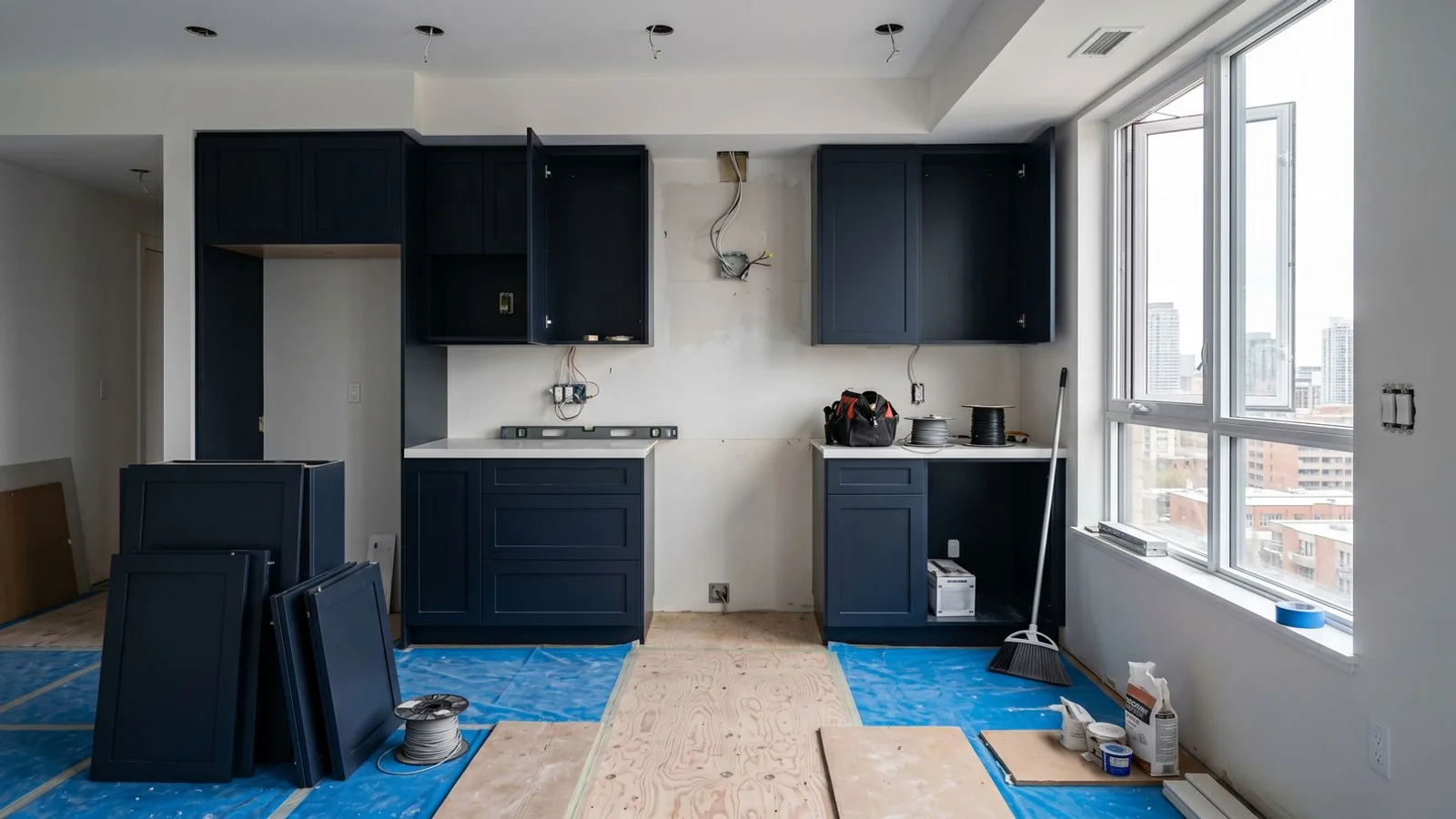
From what I’ve seen, standard Toronto condo renovation rules act as the absolute dividing line between a smooth project and a total nightmare.
We know that getting shut down mid-demolition by property management is a costly mistake most owners only make once. This guide breaks down the typical regulations you will face and the exact workarounds our team uses to keep things moving.
Let’s look at the actual documents you need, the restrictions to expect, and how to verify everything before committing your budget.
Where the Toronto condo renovation rules live
Every Ontario condo corporation has three specific documents that govern renovation work under the Condominium Act. We always pull these files first because they dictate exactly what you can and cannot do to your unit. These governing files are typically managed by larger firms like Crossbridge Condominium Services or Del Property Management.
- The Declaration: This is the foundational document filed with the corporation. It strictly sets out what unit owners can and cannot modify.
- The Bylaws: These are the corporation’s internal guidelines. They often include specific procedures and the required forms for submitting a renovation request.
- The Rules: These cover day-to-day operations. This section is usually where working hours, noise limits, and elevator booking procedures live.
Property management can give you copies of these documents upon request. Our team also recommends asking for the building’s renovation manual, which many newer towers publish to summarize everything in one convenient place.
Working hours
The single most consistent restriction across Toronto condos is that renovation work is limited to weekdays from 9 AM to 5 PM. While Toronto’s municipal noise bylaw actually permits construction from 7 AM to 7 PM, condo boards legally enforce much tighter windows.
Common variations include:
- Strict (older downtown buildings): Monday through Friday, 9 AM to 5 PM only. They allow absolutely zero weekend or after-hours work.
- Standard: Monday through Friday, 8 AM to 6 PM. Some boards permit quiet work on Saturdays until noon.
- Liberal (some newer buildings): Monday through Saturday, 8 AM to 6 PM.
We schedule the entire project strictly against your building’s published hours. Demolition is usually the loudest phase, so contractors often tackle it first thing in the morning to maximize the noise window.
Noise limits
Even within approved working hours, many boards place strict limits on the specific type of noise generated, often capping decibel levels. We frequently see property managers shut down sites that exceed standard noise limits without prior warning. These regulations are usually stricter in pre-2000 buildings where older suite separations transmit sound easily.
- Impact tools: Jackhammers, rotary hammers, and heavy demolition saws are sometimes restricted to narrow morning windows.
- Concrete drilling: Core-drilling for new plumbing is closely monitored and limited to specific hours.
- Continuous loud work: Projects producing more than 30 minutes of heavy noise often require 48 hours of advance notice to neighbours.
Permitted modifications
Certain aesthetic upgrades, like swapping cabinets or painting, usually bypass the need for a complex board review. We find that basic surface changes are typically straightforward to execute.
What you can usually change right away:
- Cabinet replacement, whether keeping the existing layout or installing new ones.
- Countertop and backsplash material replacements.
- Appliance swaps like sinks, faucets, and dishwashers in their existing locations.
- Light fixture updates within existing ceiling boxes.
- Standard paint and finish work.
- Floor finishes, though these remain completely subject to strict underlayment rules.
Other specific upgrades require formal board approval but usually pass without issue.
What requires board approval but is usually granted:
- Layout changes within the suite, such as moving cabinets or adding a kitchen island.
- Plumbing relocation within your individual unit boundaries.
- Adding or relocating a range hood, provided the existing ducting allows it.
- Pulling new electrical circuits, as long as they stay within your existing panel capacity and get inspected by the Electrical Safety Authority (ESA).
Prohibited modifications
Certain structural and systemic changes, like moving load-bearing walls or plumbing risers, are almost universally rejected by condo boards. Our engineers rarely waste time proposing alterations that affect the core building integrity.
What property managers will almost always deny:
- Load-bearing walls: Modifying these impacts building safety, so boards rarely permit structural changes.
- Plumbing risers: The vertical plumbing stack belongs to the condo corporation, not your suite. You cannot propose moving it.
- Balcony envelope: Glazing, exterior doors, and exterior cladding count as common elements.
- Ventilation through the building exterior: Cutting through the outside cladding for a new exhaust pipe is rarely approved.
- Heating, cooling, and sprinkler systems: Building management controls these systems, and modifications require strict approval from the corporation’s mechanical engineer.
- Concrete slabs: Drilling deep into the floor can hit post-tension cables or structural rebar, making deep core drilling highly restricted.
Floor finish rules
When reviewing condo renovation bylaws, Toronto boards enforce strict Sound Transmission Class (STC) ratings for any new flooring to prevent noise from reaching the suites below. We see premium buildings requiring an Acoustic Underlayment Certificate before a single plank goes down. While the Ontario Building Code mandates a minimum STC rating of 50, luxury condos often demand a rating of 72 or higher.
- Hardwood and tile: These materials require a specific, high-density underlayment to maintain the building’s acoustic ratings.
- Carpeted areas: Converting a carpeted bedroom to a hard surface sometimes requires a special variance or acoustic engineer approval.
- Building STC and IIC ratings: Your contractor must specify an underlayment product that matches or exceeds the board’s minimum requirements.
Our team builds the floor finish specifications right into the initial design scope. Verifying these exact ratings against the building rules prevents costly tear-outs later.
Variance between buildings
The age and location of a tower dictate entirely different downtown condo renovation rules, with pre-1990s buildings being the strictest. We adapt our project timelines based on which generation of building we are entering.
- Pre-1990 downtown towers: These present the strictest renovation environment. They feature strong board oversight, very narrow working hours, and often require a dedicated committee to review your application.
- 1990s to 2000s buildings: Towers along the Yonge corridor, Yonge-Eglinton, and the Bay Street area are usually moderate. They typically have clear renovation manuals, but management enforces the rules very strictly.
- Post-2010 buildings: Condos in CityPlace, Liberty Village, and the Vaughan Metropolitan Centre are usually the most renovation-friendly. They offer modern building infrastructure, well-documented procedures, and quick approval turnarounds.
- Heritage-designated buildings: Any modification to original architectural features in these buildings requires another massive layer of approval, sometimes involving Heritage Toronto directly.
Self-qualifying your renovation
Before paying for initial design fees, request your condo’s Status Certificate to see if there are immediate red flags regarding unit upgrades. We always recommend completing a quick self-test to determine your next steps.
Quick self-test to assess your scope:
- Can you change cabinets, counters, and finishes? The answer is almost always yes.
- Are you moving plumbing within your suite? This is usually fine, provided you secure board approval.
- Are you removing or modifying any walls? Get clarification first, because you cannot touch load-bearing concrete.
- Are you installing a new range hood with new ducting? You must verify your existing ducting feasibility first.
- Are you working outside standard 9 AM to 5 PM windows? This is almost certainly banned unless you pay heavy after-hours security surcharges.
If your project falls into the “almost always yes” categories, you can proceed with confidence. Projects landing in the “depends” or “rarely permitted” categories require a direct conversation with property management before you finalize any designs. Getting that early confirmation saves you from paying architectural fees that cannot be recovered if your approval falls through.
How we navigate this for you
Before issuing any contract, our project managers coordinate directly with property management to secure full board compliance. This step ensures you never have to guess what paperwork is missing.
The standard pre-construction process includes:
- Requesting and reviewing documents: The team pulls the declaration, the renovation manual, and the required building permits.
- Verifying scope feasibility: We cross-reference your design against the building’s published rules.
- Pre-confirming with management: Submitting our required WSIB clearance and $5 million liability insurance certificates happens next.
- Identifying high-risk elements: We spot structural details that need engineer drawings or an extended board review.
- Building the schedule: Trade deliveries and demolition are aligned strictly against the building’s working-hour rules.
This mandatory pre-contract diligence regarding Toronto condo renovation rules is exactly why our condo project approval rate stays at essentially 100%. Book a free in-suite consultation for your project, or read about the full board approval process to understand the timeline.
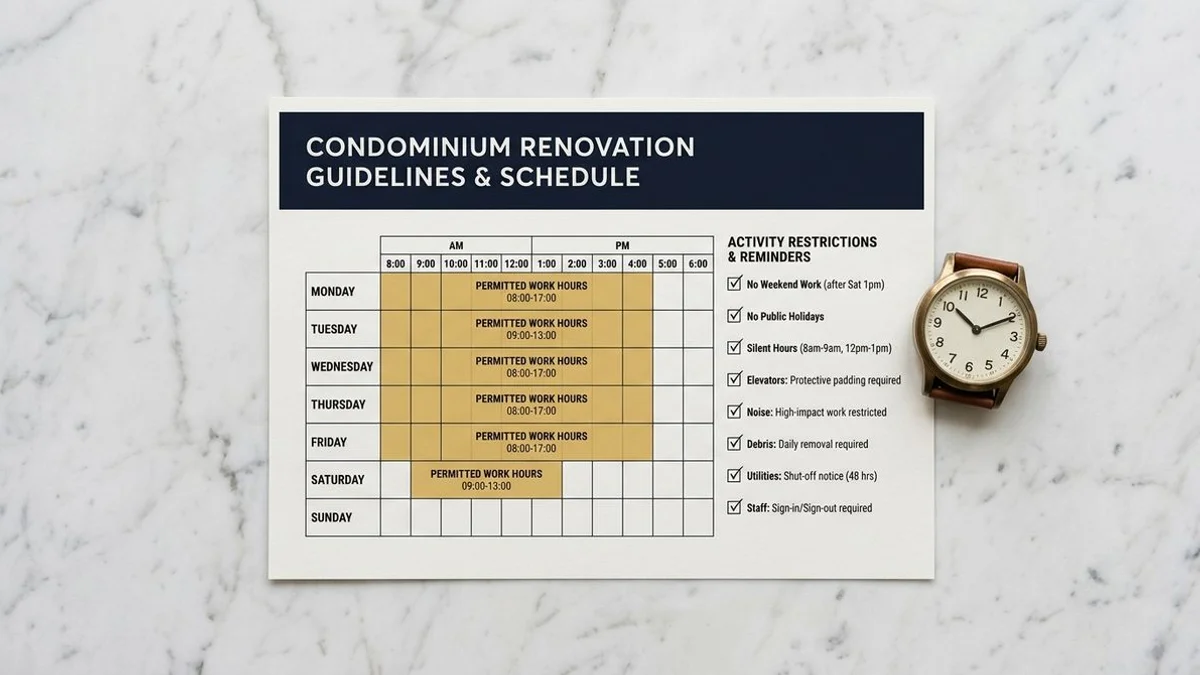
Visual summary of Toronto condo renovation rules