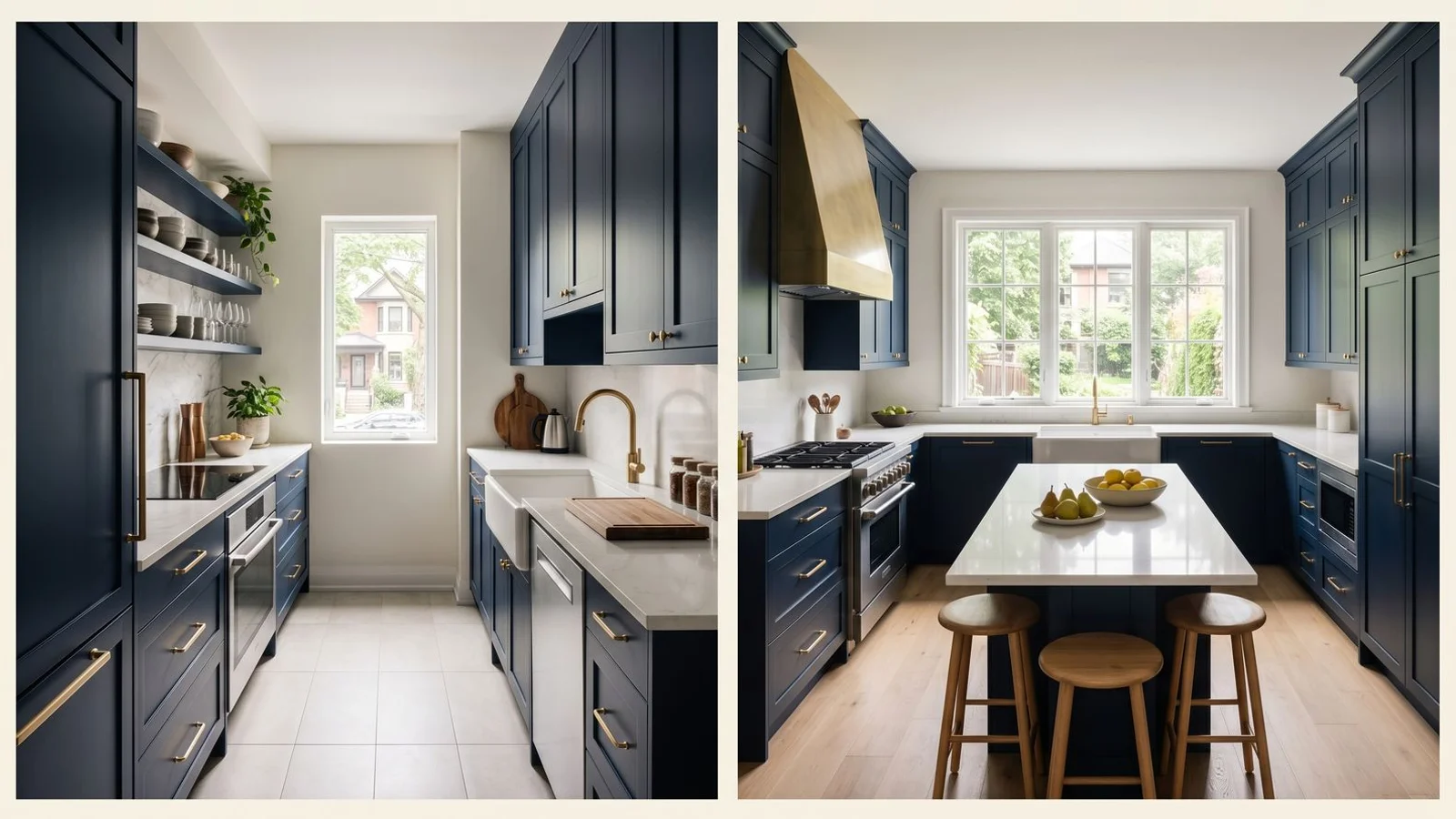
You know how a simple cabinet swap can suddenly spiral into a full structural debate. Renovating a Toronto condo kitchen and a Toronto house kitchen are almost completely different projects, even when the finishes are identical.
Our team has guided hundreds of homeowners through these exact logistical hurdles.
The permit approvals and building rules dictate the entire workflow. We compiled this breakdown to clarify the specific 2026 data and regulations.
Let’s explore the details and plan your specific condo vs house kitchen renovation.
Scope differences
The scope of your project depends entirely on your building type. Condos restrict you to cosmetic and localized updates, while houses allow for major structural and system overhauls.
In a Toronto house, you can remove load-bearing walls with proper engineering, relocate plumbing throughout the home, and exhaust a range hood directly through an exterior wall. You also have the freedom to upgrade your electrical panel to support an induction stove, provided you secure an Electrical Safety Authority (ESA) inspection.
Condos almost universally reject plumbing riser modifications or altering structural concrete. Property management companies like FirstService Residential will require detailed architectural drawings just to prove you are not touching common elements. Even adding a simple Ground Fault Circuit Interrupter (GFCI) outlet within 1.5 metres of your sink requires strict coordination with the building’s specific electrical infrastructure.
| Project Element | House Kitchen Scope | Condo Kitchen Scope |
|---|---|---|
| Structural Walls | Removal allowed (requires engineering/permits) | Changes strictly prohibited |
| Plumbing | Full relocation possible across multiple floors | Riser modifications always denied |
| Ventilation | Range hood ducting through exterior wall | Changes limited to existing ducting feasibility |
| Flooring | Subfloor modifications easily approved | Requires strict noise transmission underlayment |
Houses clearly offer more design flexibility. Condos demand extreme precision within a very constrained footprint.
Timeline differences
Project timelines diverge wildly because of the administrative hurdles involved. House renovations wait on city permits, whereas condo projects wait on board approvals.
The City of Toronto targets 10 business days for a House Stream permit review in 2026. The real-world timeline from submitting documents via the ePlans portal to holding a legal permit is typically 6 to 12 weeks for a clean application.
Condo administrative phases operate on an entirely different track. Securing board approval often takes 2 to 6 weeks, though complex electrical requests can stretch to 8 or 10 weeks depending on the property manager’s review cycle.
| Project Phase | House Timeline | Condo Timeline |
|---|---|---|
| Design & Contract | 2-3 weeks | 2-3 weeks |
| Approvals/Permits | 6-12 weeks (City ePlans review) | 2-6 weeks (Condo Board review) |
| Cabinet Fabrication | 4-6 weeks | 4-6 weeks (Runs parallel with approvals) |
| On-Site Work | 4-8 weeks | 3-5 weeks |
| Total Estimated Time | 10-16 weeks | 10-14 weeks |
Once on-site, a condo kitchen progresses faster because the footprint is smaller. A house kitchen generally requires a longer active construction phase to handle the expanded structural scope.
Cost differences
Budgeting for these projects requires looking at completely different line items. Total project costs are usually lower for condos due to their overall size, but the per-square-foot cost is noticeably higher.
A medium-sized house kitchen in the Greater Toronto Area averages between $30,000 and $60,000 for a mid-range full renovation. Luxury full-gut projects in single-family homes easily exceed $80,000. Standard condo renovations typically run $20,000 to $40,000 because the footprint is usually limited to 60 to 150 square feet. This smaller physical space prevents any material economies of scale.
| Renovation Level | House Kitchen (Toronto 2026) | Condo Kitchen (Toronto 2026) |
|---|---|---|
| Standard / Refresh | $15,000 - $30,000 | $20,000 - $40,000 |
| Mid-Range Full Renovation | $30,000 - $60,000 | $40,000 - $60,000 |
| Premium / High-End | $80,000 - $200,000+ | $60,000 - $100,000 |
Condos also carry hidden logistical fees that inflate the cost per square foot. You need to budget for specific high-rise constraints.
- Elevator deposits: Often $500 to $1,000 refundable fees required before moving materials.
- After-hours surcharges: Extra billing if trades get delayed by restrictive working windows.
- Common-area protection: Mandatory floor and wall coverings from the loading dock to your front door.
Contractor specialization
Hiring the right team means matching their expertise to your specific property type. A contractor who excels at a condo vs single family kitchen renovation understands these drastically different environments.
Our project managers implement strict administrative protocols for every multi-family building we enter. Boards typically demand a certificate of insurance proving $2 million to $5 million in commercial general liability before a single tool passes the lobby.
House kitchen contractors generally need a standard municipal licence, Workplace Safety and Insurance Board (WSIB) coverage, and building permit filing experience. Condo specialists must manage a completely different set of requirements:
- Experience submitting detailed condo board renovation applications.
- Deep understanding of typical Toronto high-rise bylaws.
- Dedicated crews trained on common-area protection protocols.
- Strict schedule discipline to maximize narrow working-hour windows.
Taking a generalist into a condo often leads to immediate problems. Trades who violate building rules face immediate eviction by the concierge, causing severe schedule delays and costly time-and-materials billing.
Trades typically involved
The number of workers in your home varies based on the scope flexibility. Houses require a larger, more diverse team to handle structural and exterior modifications.
A single-family kitchen remodel usually involves 8 to 12 distinct trades, including framers, exterior ducting specialists, and drywallers. Condos rarely need more than 5 to 7 specialized trades, bypassing framing and exterior work entirely.
Both property types share strict regulatory requirements for core systems:
- Electrical work: By law, any significant wiring changes must be completed by a Licensed Electrical Contractor (LEC) to meet the Ontario Electrical Safety Code.
- Plumbing: Licensed plumbers must handle all fixture installations to prevent catastrophic water damage across multiple floors.
- Custom finishing: Both scenarios require dedicated cabinet installers, tile setters, and stone fabricators.
This narrower trade list is a major reason condo on-site execution is typically much faster.
Living situations during renovation
Your comfort during construction depends heavily on the available square footage. House owners can usually isolate the mess, while condo dwellers often need to relocate.
Families in a single-family house usually set up a temporary prep area in a dining room and live through the 4 to 8 weeks of disruption. Condos lack this critical buffer zone.
The dust and noise in a 700-square-foot unit are incredibly difficult to tolerate. Commercial HEPA scrubbers help reduce airborne particles, but many condo owners still choose to move out entirely during the most disruptive phases.
- Short-term rentals: With Toronto furnished rentals averaging $1,575 to $2,937 per month in 2026, you must factor this relocation cost into your budget.
- Hotel stays: Useful for short 3-to-5 day windows during cabinet installation or floor sanding.
- Strategic travel: Scheduling the heavy installation phase to coincide with a planned vacation is a highly effective way to save money and reduce stress.
Decision factors
Deciding when to pull the trigger on a house renovation vs condo renovation comes down to your timeline, budget, and potential property value gains. You need to ensure the investment aligns with your long-term housing plans.
The Appraisal Institute of Canada indicates that a well-executed kitchen renovation provides a 75% to 100% return on investment upon resale. This is especially true in the Toronto market where buyers heavily prioritize updated cooking spaces.
Your specific property type dictates different investment strategies.
- Choose to renovate your condo when: The current kitchen is highly dysfunctional, you plan to stay 5 or more years, and your budget supports the $20,000 to $40,000 typical range. Premium downtown units see exceptionally strong resale bumps from integrated appliances.
- Choose to renovate your house when: The existing layout is fundamentally wrong for your growing family, you plan to stay long-term, and your budget supports $40,000 to $80,000 for a meaningful structural change.
- Avoid major renovations when: You are listing the property within 12 months. A cosmetic rental refresh yields a higher percentage return than a luxury overhaul if the existing space is already functional.
How we approach both
Our team applies the exact same fixed-price contract model to every single project. This guarantees absolute financial predictability regardless of your building type.
We handle both condo and house renovations with a dedicated, single-team structure. The practical differences mostly play out during the critical project management phase.
Our coordinators manage the strict board approvals and elevator booking workflows for high-rise clients. House projects run through the Toronto Building permit process and intensive trade coordination schedules. We prioritize clear communication so you know exactly what is happening each week.
Browse our condo kitchen renovation service or our home kitchen renovation work, or book a free in-home (or in-suite) consultation to scope your project. For condo cost detail, see the Ontario condo kitchen cost guide.
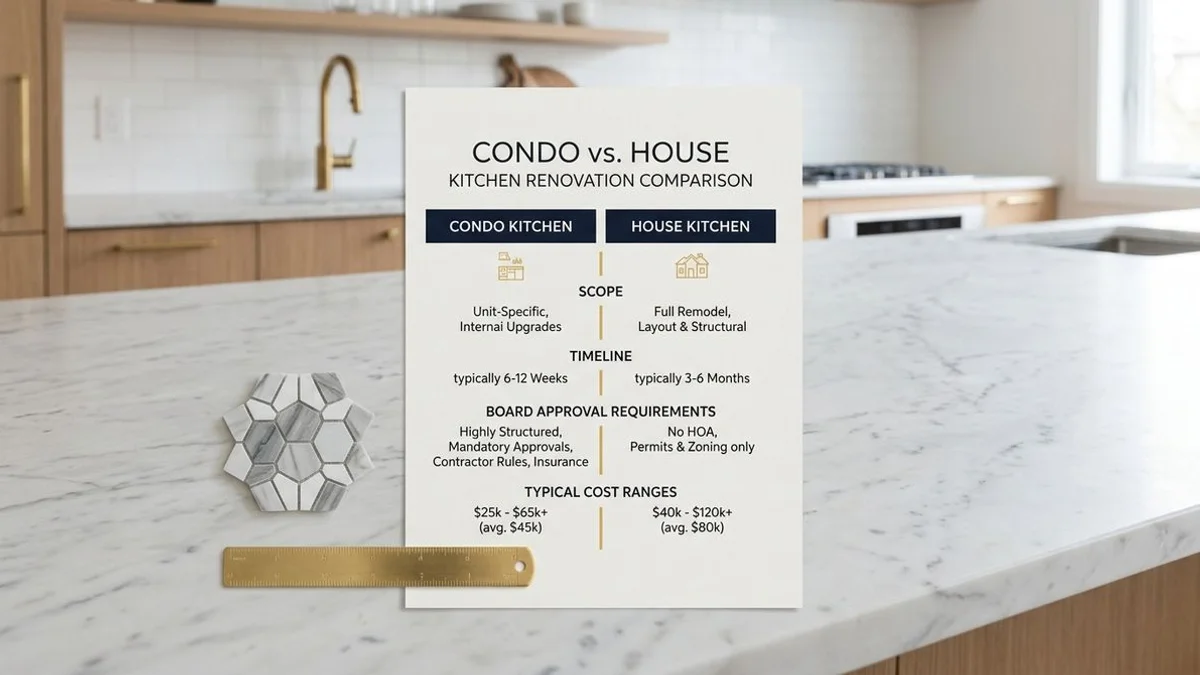
Comparison chart: condo vs house renovation scope, timeline, cost, restrictions